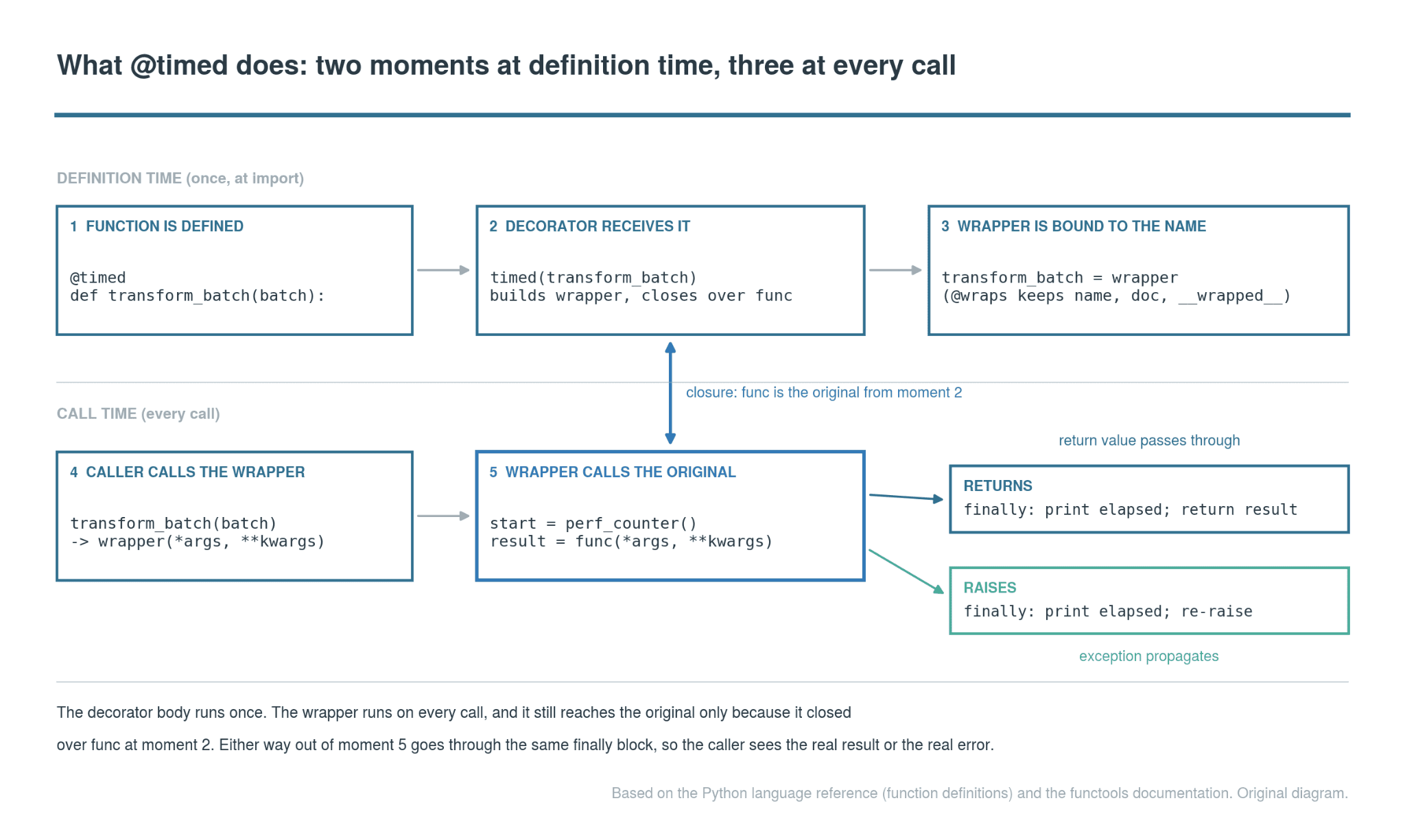
In this article, you will learn how Python decorators work under the hood and how to build reliable ones for timing, retries, caching, and input validation.
Topics we will cover include:
How the @ syntax, closures, and functools.wraps combine to make a decorator that preserves the original function’s behavior and metadata.
How to build a timing decorator and a configurable retry decorator factory that never hide exceptions.
When to use functools.lru_cache and a signature-based validation decorator, and when a decorator is the wrong tool.
The feature pipeline module started with three clean functions. One loads embeddings from a local store, one fetches a vocabulary from an internal service, and one transforms a batch. Six weeks later, a third of each of them is boundary code. load_embeddings checks that its path exists and its batch size is positive before it does anything. fetch_vocab wraps its request in a for attempt in range(3) loop with a time.sleep() inside it.…