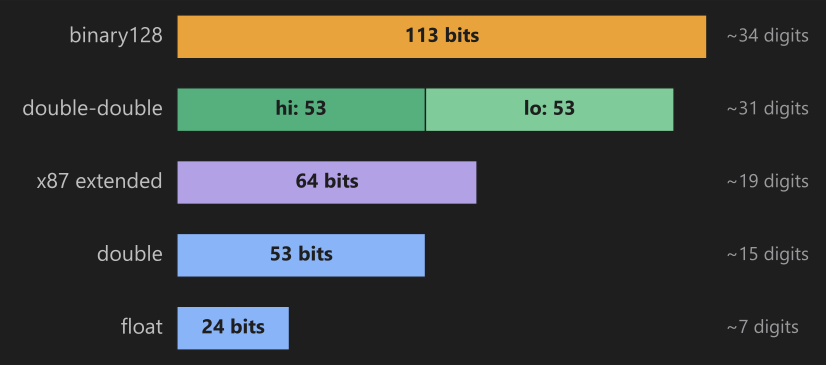
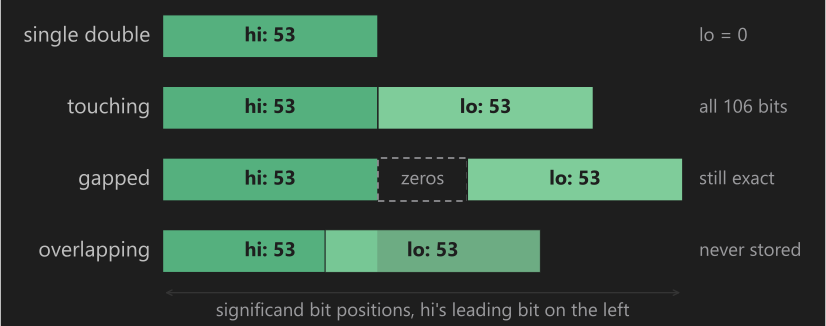
If you ever need more precision than what 15 decimal digits of the double format can offer, there is a neat trick: glue two doubles together and treat them as one number. This gives you ~31 decimal digits for roughly 9x the cost of a plain double in a real kernel (4-12x per isolated operation). With no heap allocation and no dependencies, this puts it almost exactly halfway between a double and an arbitrary-precision library perf-wise. This post explains the error-free transformations that make it work, measures it against MPFR, and shows where the trick runs out of steam.
The gap nobody fills #
Floating-point types come in many "flavors". For example, a float has ~7 decimal digits, a double ~15, both basically for free. An arbitrary-precision library gives you as many digits as you want, at a painful per-operation cost. Between "not quite enough" and "orders of magnitude slower" there is a gap and I fell into it while zooming deep into the Mandelbrot set.…