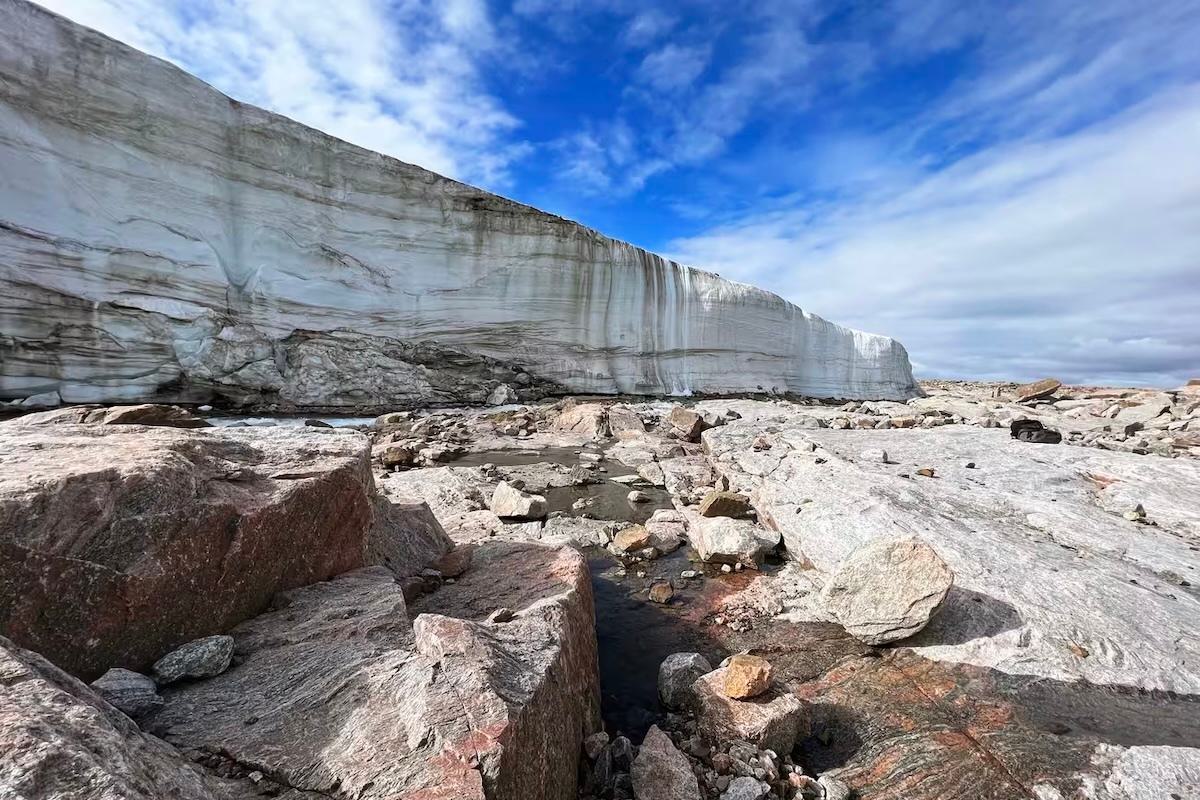
The Barnes ice cap on Baffin Island in northern Canada. Nicolás Young
Researchers have found evidence that warming, driven by the burning of fossil fuels, reversed the advance of a new ice age.
The study, published in the journal Science , tracks the advance and retreat of the Barnes ice cap, on Baffin Island in northern Canada. The ice cap is the last surviving remnant of the massive Laurentide ice sheet that once sprawled across North America, from the Arctic Ocean to Manhattan, during the last ice age.
Around 2,000 years ago, the Barnes ice cap began to expand, signaling the beginnings of a new ice age, the study found. But by the 1960s, summers were so warm that the ice began to shrink again. Scientists were able to track the movement of the ice cap by analyzing ancient vegetation exposed by melting ice. By carbon dating the vegetation, they could determine when the ice cap had first advanced.
A satellite image of the Barnes ice cap.…