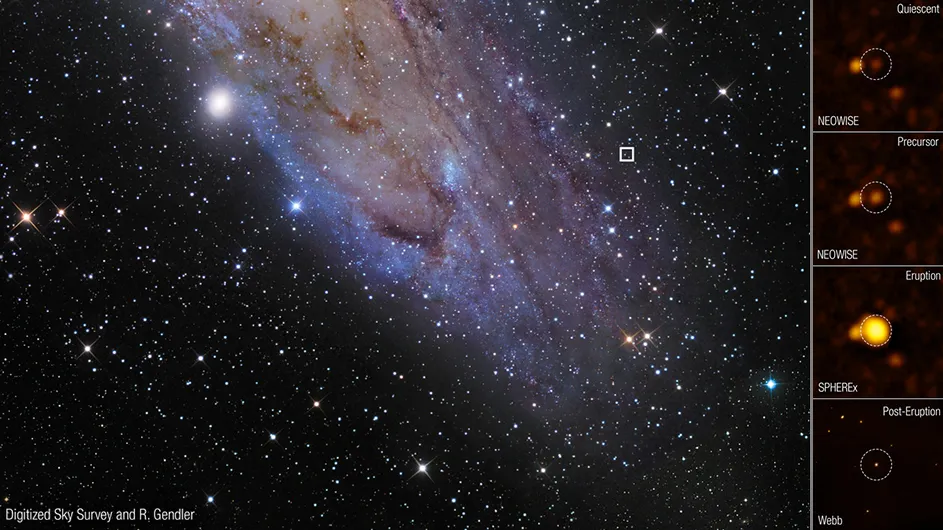
A recent brightening turned out to be from a star orbiting inside another.
Over the course of years of observation, the star changed dramatically.
Credit:
DSS and R. Gendler
Over the course of years of observation, the star changed dramatically.
Credit:
DSS and R. Gendler
In the Andromeda Galaxy, a giant star about seven times as massive as the Sun spent nearly a decade slowly swallowing its much smaller companion. The process, known as common envelope evolution, was proposed in the 1970s to explain how some of the tightest pairs of stars in the Universe form, but no one had ever caught it in the act.
In a new Nature study, astronomers led by Viraj Karambelkar, an astrophysicist at Columbia University, finally witnessed the entire spectacle from the decades before it began to the eruption that ended it in late 2025. “It lasts for a few years, maybe a few decades,” Karambelkar said. “Stars evolve on time scales of millions of years.…