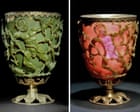
The Romans’ proficiency in the art of glass-making has produced some of the wonders of antiquity, but few of their creations better a 1,600-year-old masterpiece which sits in the British Museum .
Depending on where a light source is positioned, the Lycurgus Cup changes colour, from jade green under normal lighting to ruby red when lit from behind – an astonishing feat of optical engineering that has confounded historians and glass-makers for centuries.
Now scientists from the University of Sheffield have replicated its remarkable optical behaviour, using an ancient recipe derived from a fragment of the Roman “dichroic” (two-coloured) original.
Dr Lisa Hollands, a technician at the university’s school of chemical, materials and biological engineering, said that replicating it has been “a labour of love” and “people have tried it before with limited success”.…