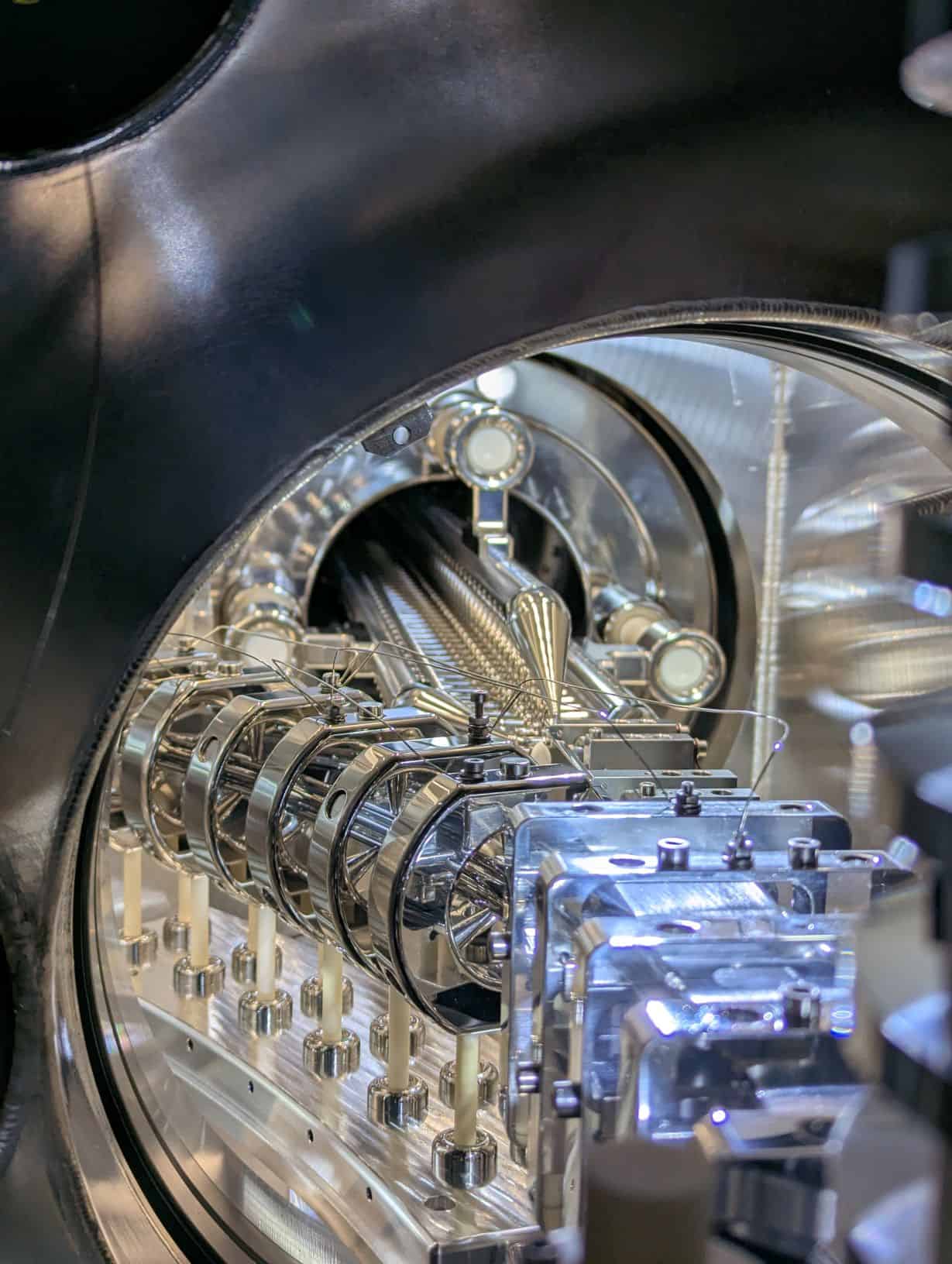
Falling in line: The inside of the experiment, where the two beams of molecules merge. (Courtesy: Yao Chang)
Researchers in the Netherlands have shown that they can turn off the dipole moment of molecules that are normally polar, drastically altering the molecules’ behaviour in low-energy collisions. The discovery – which was only possible after the team cleared a major experimental hurdle – has implications for ultracold chemistry and could also lead to a better understanding of polarity, with benefits for quantum simulation and computation.
Chemical reactions are full of complexity and chaos, making them hard to study at the atomic and molecular level. Before attempting to do so, scientists typically cool the reactants to just above absolute zero, which restricts their movement and vibrations.…