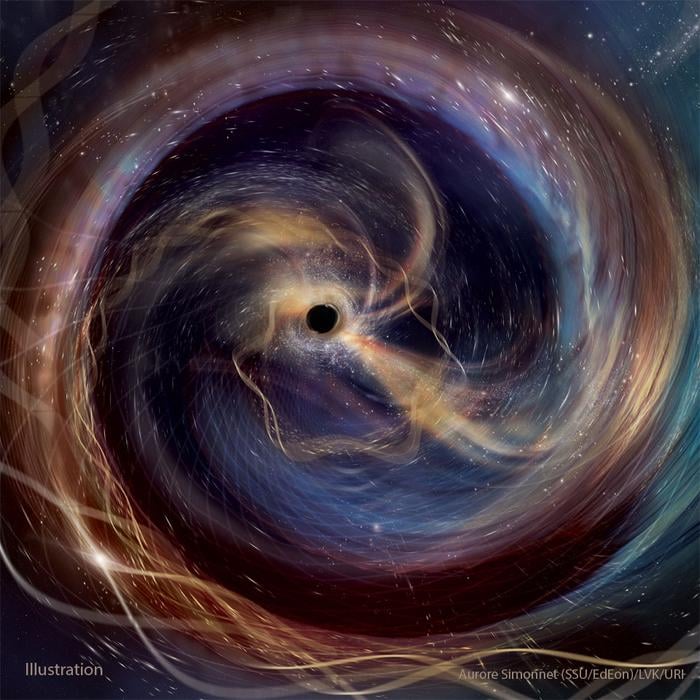
Black holes remain some of the most mysterious and awe-inspiring celestial objects ever studied. This primarily comes from the fact that they literally can’t be observed unless they interact with something in its surrounding environment, most notably a star. Adding to their mystery, several types of black holes exist, including free-floating black holes that drift independently throughout space, stellar-mass and are produced from exploding stars, and supermassive black holes that exist at the center of galaxies like our own. But arguably one of the most mind-blowing mysteries about black holes is figuring out what happens when they collide, and even merge.
Now, a team of more than 70 researchers might be one step closer to solving this decades-long conundrum as they used a combination of computer models and a literature review to analyze how black holes behave when they collide, specifically focusing on a well-known “ringing” phenomenon that occurs when black holes collide and merge.…