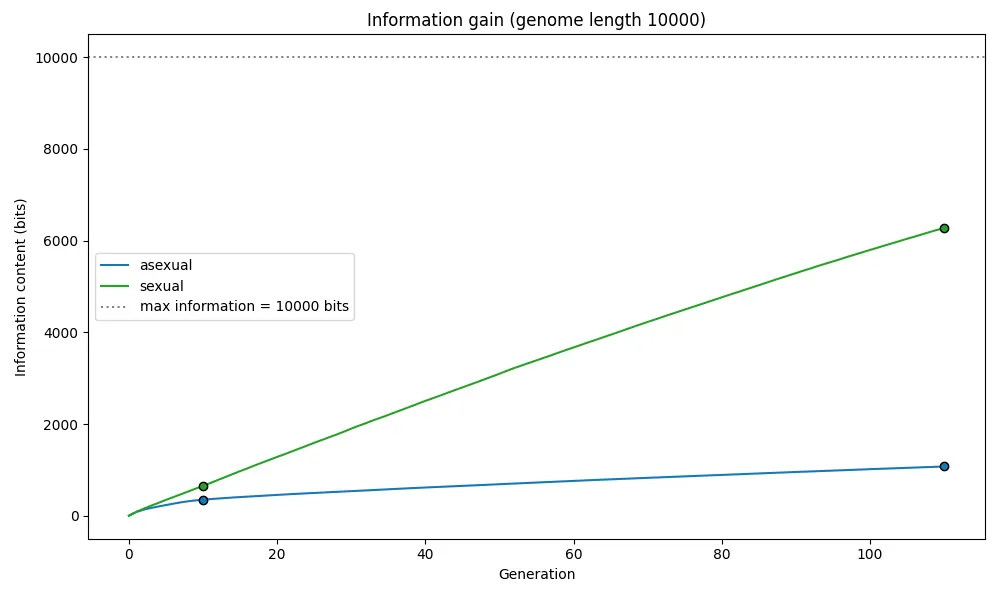
A few weeks ago we looked at a simulation of technological evolution by economist Brian Arthur, in which he was able to start with simple building blocks (such as a NAND gate) and evolve surprisingly complex circuits (such as a 12-way AND gate or a 4-bit adder) by randomly combining increasingly useful existing components. We analyzed this as a way of simplifying a search problem: by using existing, working components as modules that can be combined, a few at a time, into more complex modules, and then combining those into even more complex modules, many unpromising and time-consuming branches of the search tree are screened off, and the simulation can find useful technologies amidst an enormous branching set of possibilities. Real human technology is, of course, not generated by randomly combining components together and seeing if they do anything useful; the randomness in these simulations is just a way to see how easy or hard it is to create new technologies under different conditions.…