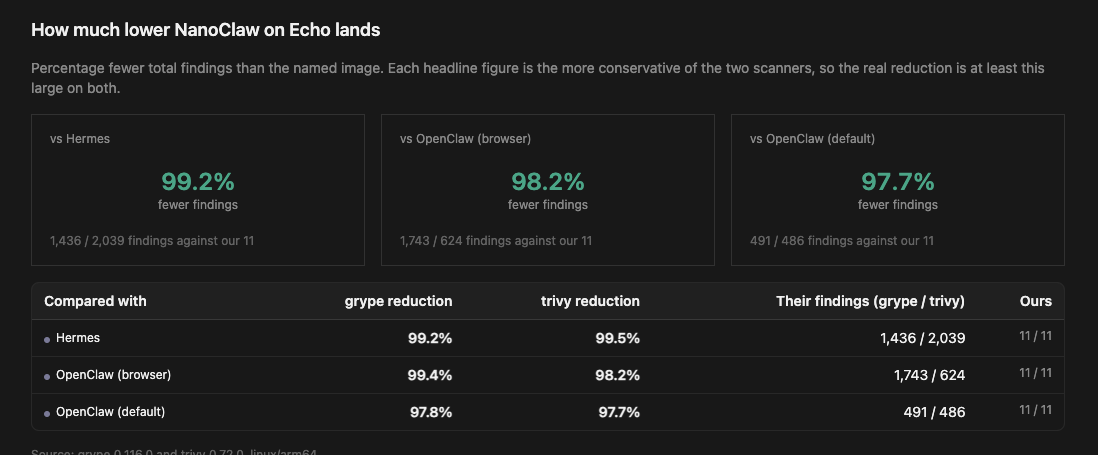
Last week we announced Echo's partnership with NanoClaw, designed to extend the vision and security of the open source project. In this post, we want to pull back the curtain and show you exactly how Echo's agentic hardening process works. How do we detect CVEs? Before we can fix anything, we need a complete, trustworthy picture of what's actually in the image. We scan and analyze the upstream NanoClaw container using several independent vulnerability scanners, including Trivy, Grype, and Wiz. Here's the raw result of scanning the open source NanoClaw image with Grype, sorted by severity: NanoClaw's default image scan results And here's how that stacks up against comparable agent runtimes (Hermes and OpenClaw) across both Grype and Trivy (we also added the NanoClaw Echo image to this comparison - which we will dive into soon): Now, let’s move to the fixing and CVE reduction. Step 1: Start with what we can safely bump Every library in the image is its own problem to solve.…
.png)
.png)


.png)
.png)
.png)
.avif)
.avif)