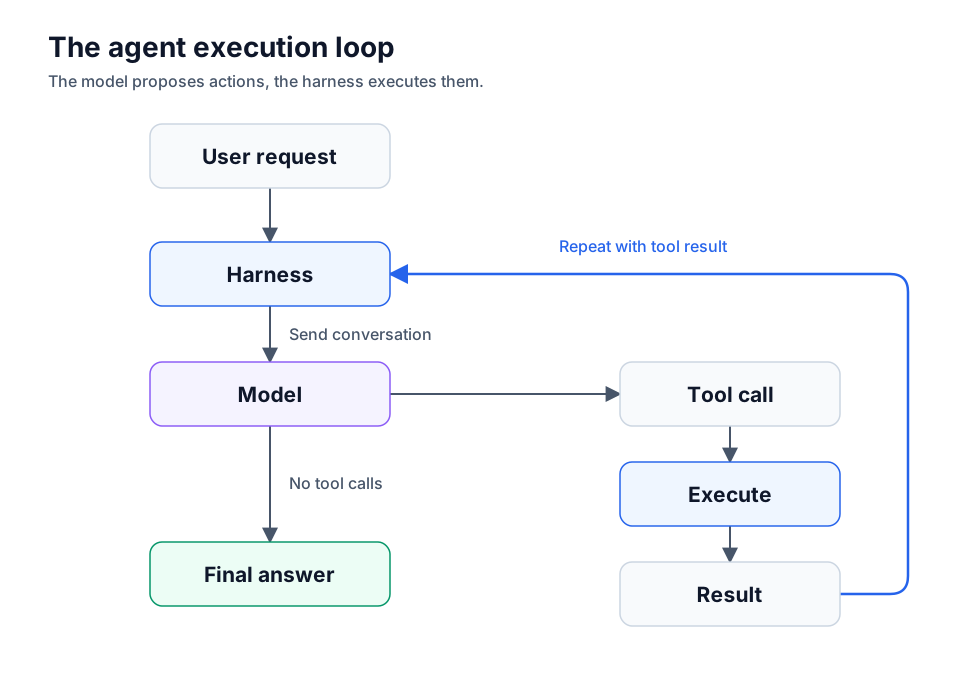
Many AI agent tutorials start with a language model, give it a few tools, and run a loop until it produces an answer. That's enough to demonstrate tool calling, but it leaves the interesting engineering questions unanswered.
What happens when a tool fails? Who validates the arguments? What prevents an agent from running indefinitely, executing unsafe commands, or exhausting its context window? And how do you test any of this without relying on unpredictable model responses?
These are responsibilities of the agent harness : the software that sits between a language model and the environment it operates in.
In this tutorial, we'll build a small, provider-independent harness in TypeScript, using a coding agent as our example. We'll start with a basic execution loop and progressively add tool validation, workspace isolation, execution budgets, context management, observability, and deterministic failure testing.
What We'll Cover
Prerequisites
1. Build the Basic Agent Loop
Test Without a Real Model
2.…