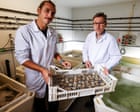
T he baby oysters, with their rough cream-coloured shells and ragged edges, are about the size of a 50 pence piece. But off the north-east coast of Scotland , they are proof of a breakthrough in marine conservation.
For the first time in the UK, scientists have succeeded in breeding wild oysters at a site where they had been locally extinct for more than a century, in the Dornoch Firth north of Inverness.
The marine conservationists hope that about 4m native European flat oysters ( Ostrea edulis) will soon colonise the restoration site, heralding a remarkable turnaround for the species.
Victorian maps, including a volume known as Olsen’s Piscatorial Atlas from 1883, established that billions of native oysters once crowded the seabed around Britain, forming vast reefs that supported rich, thriving marine ecosystems.
Within decades they were fished to extinction across the North Sea, the Channel and countless fisheries around the coast, shipped in bulk on Britain’s new railways to feed the country’s…