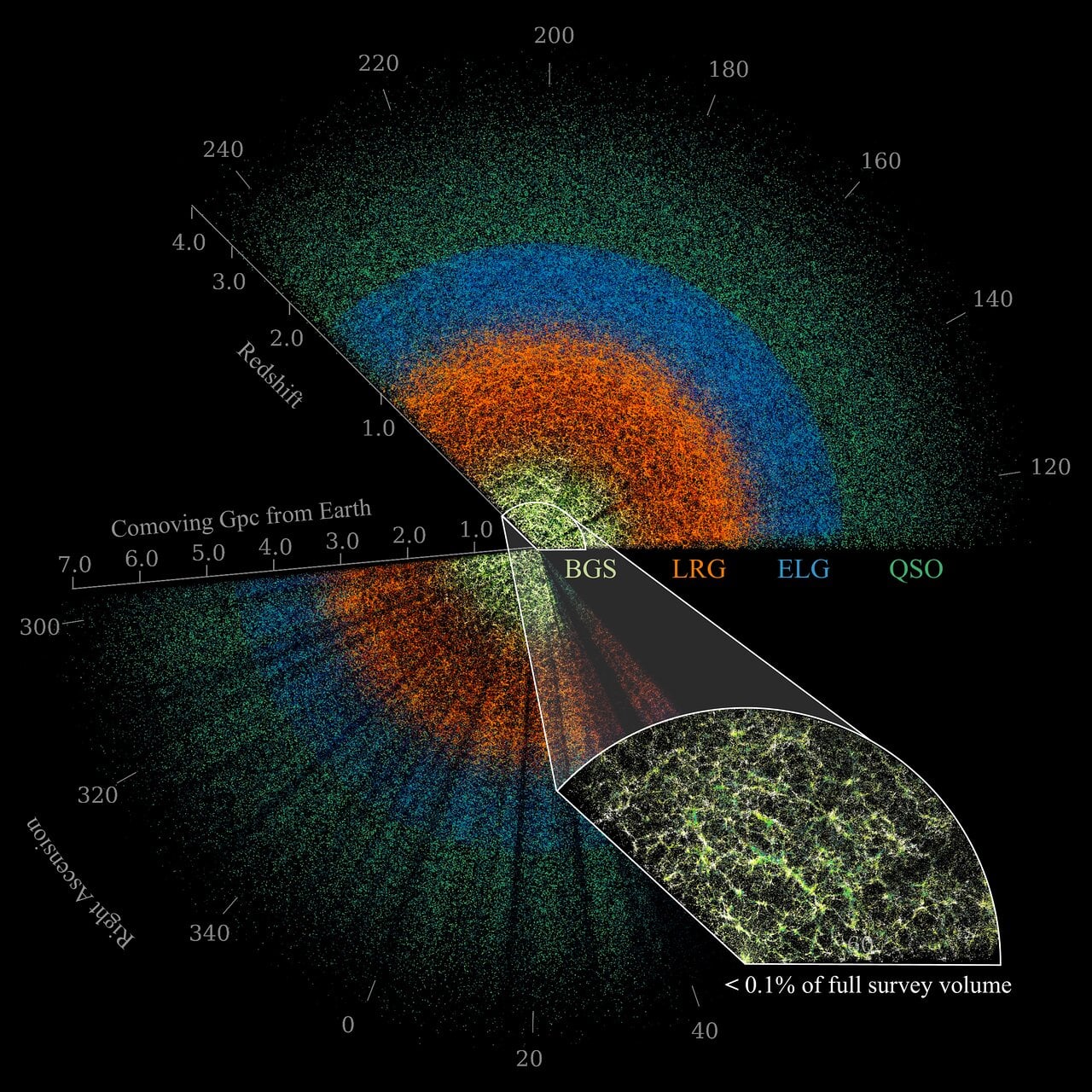
Advances in computing and astronomy have led to increasingly complex attempts to chart the large-scale structure of the Universe. For the past decade, scientists have been working to map one aspect in particular to see whether it matches observations of the cosmic web: cosmic hydrogen. For the first few hundred million years after the Big Bang, neutral hydrogen was the only element in the Universe (known as the " Cosmic Dark Ages ") and provided the feedstock for stars, galaxies, and the cosmic web.
Today, it remains the most abundant element in the Universe and can be found everywhere - the interstellar medium (ISM) and the intergalactic medium (IGM) - in abundance. For the past decade, scientists with the MeerKLASS Collaboration have been trying to measure how neutral hydrogen "clumps" in the distant Universe.…