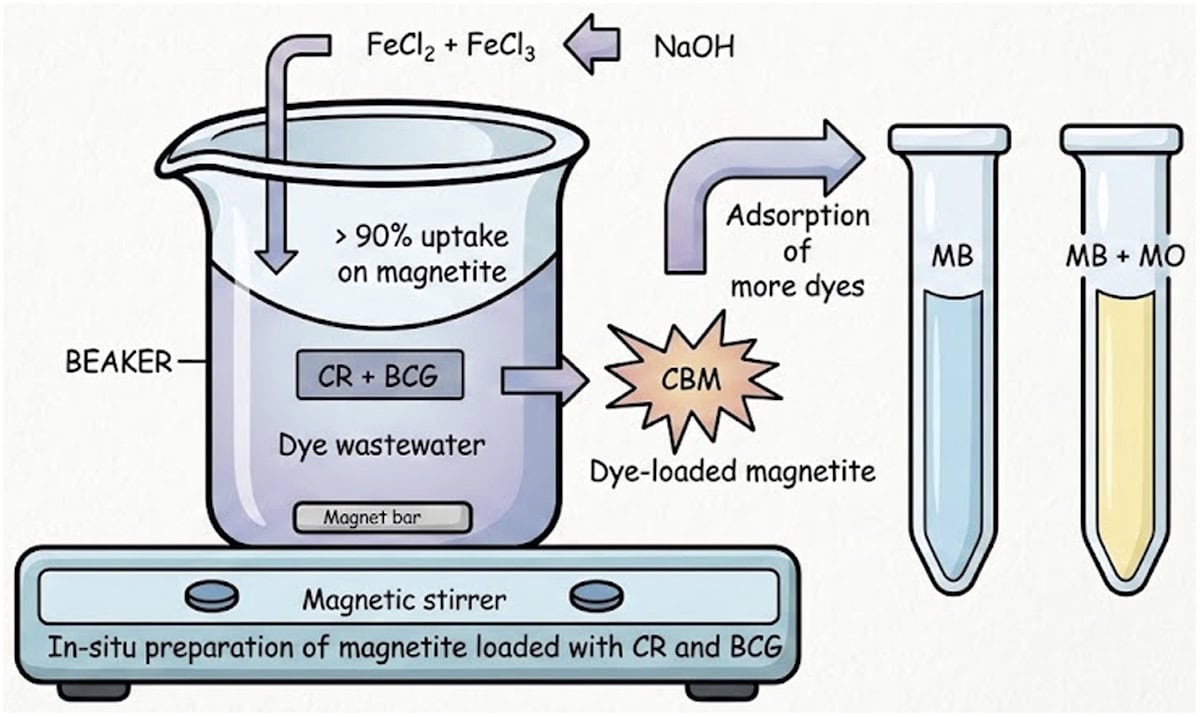
Little cleaners The nanoparticles form directly in dye-polluted water, soaking up more than 90% of two dyes (congo red and bromocresol green) as they're made – then go on to catch even more dyes (methylene blue and methyl orange) afterward. (Courtesy: used with permission of Royal Society of Chemistry, from H H Farghal et al. RSC Adv. 10.1039/d6ra06557k, 2026; permission conveyed through Copyright Clearance Center)"> Little cleaners The nanoparticles form directly in dye-polluted water, soaking up more than 90% of two dyes (congo red and bromocresol green) as they're made – then go on to catch even more dyes (methylene blue and methyl orange) afterward. (Courtesy: used with permission of Royal Society of Chemistry, from H H Farghal et al. RSC Adv. 10.1039/d6ra06557k)
Each year, approximately 5000 tonnes of dyes (about 50 times the weight of a blue whale) are discharged into industrial wastewater.…