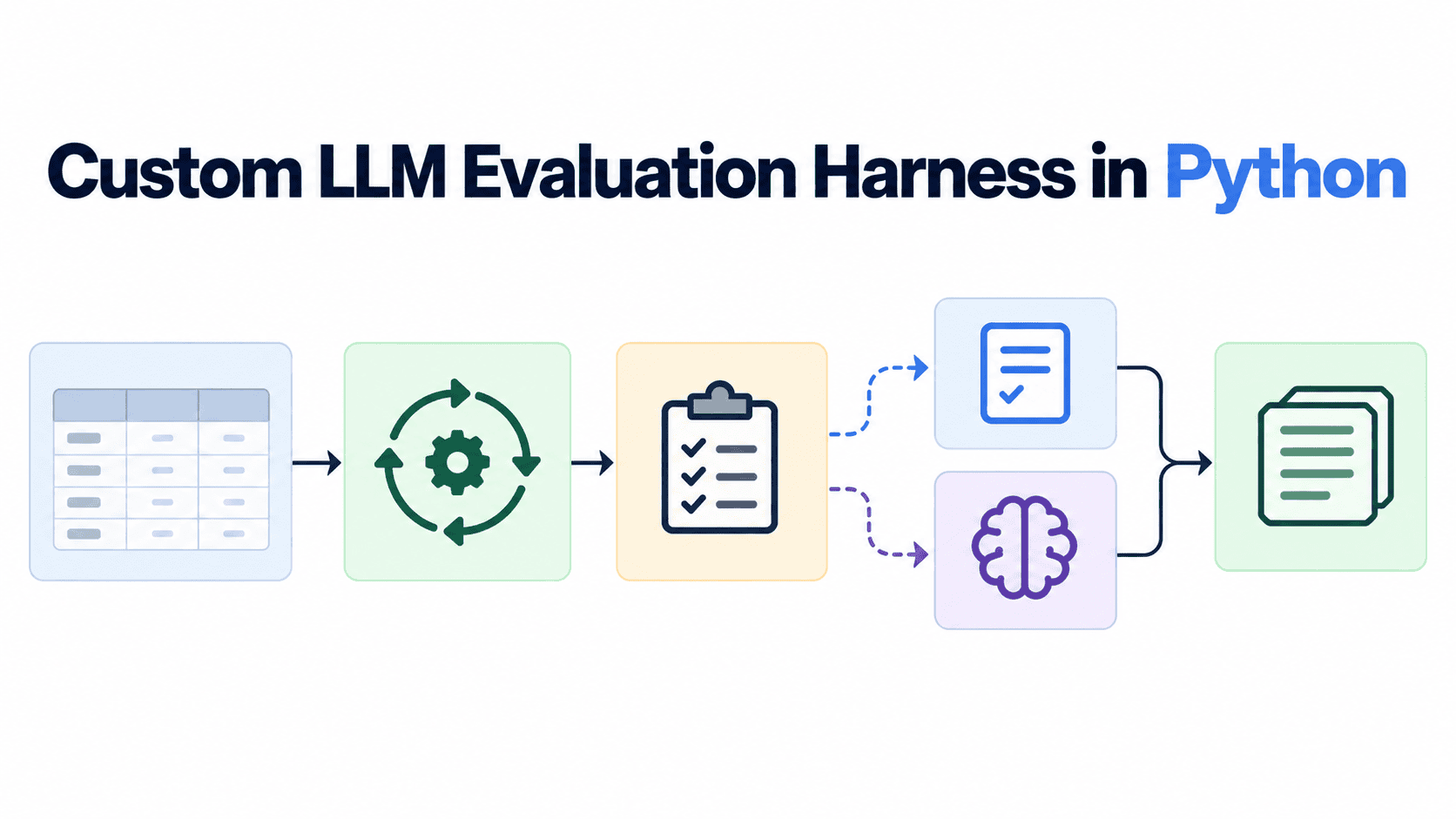
In this article, you will learn how to build a custom LLM evaluation harness in Python from scratch, structured around four modular components that give you full control over how your models are tested and scored.
Topics we will cover include:
How to construct a golden dataset of test cases grounded in real user inputs and known failure modes.
How to build an async inference runner and a two-mode judge layer using both deterministic and LLM-based scoring.
How to log results in a crash-safe format that decouples scoring from inference, so you can re-score without re-running expensive API calls.
Public benchmarks like MMLU or GSM8K measure general capability, but they won’t tell you whether your customer support agent follows your refusal policy, or whether your RAG pipeline pulls the right context for your specific domain. For that, you need something you own.
That’s where a custom evaluation harness comes in: a repeatable pipeline built around your test cases and your scoring criteria.…