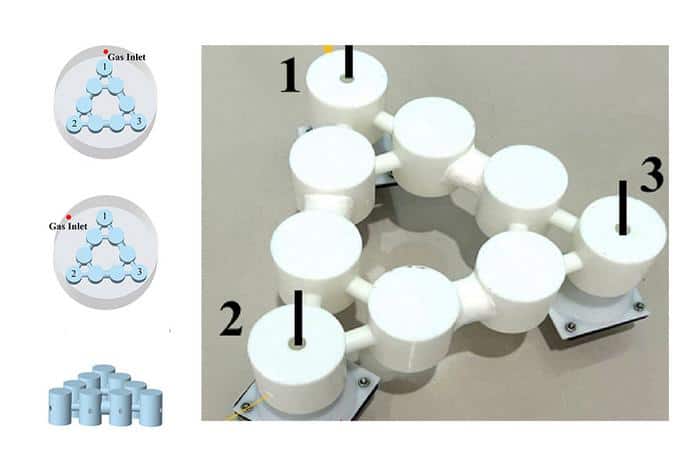
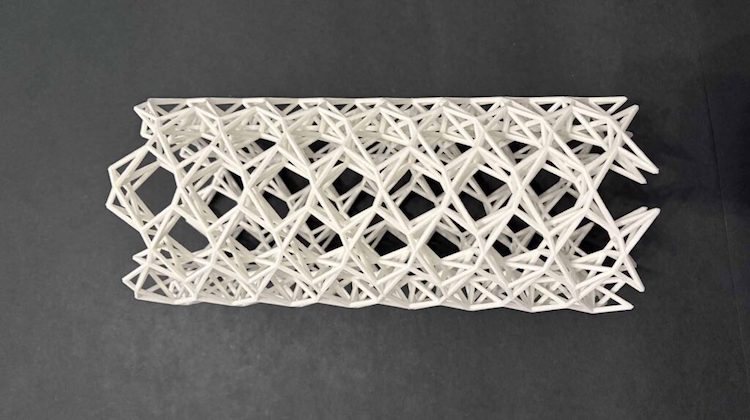
et al. )"> Cylinders and tubes: The structure of the helium detection device was inspired by the Japanese bamboo-weaving technique known as Kagome-biki. This triangular structure (shown in detail at left) helps users determine the location of helium leaks in a 2D space. (Courtesy: Wang et al. )
A new sensor detects helium leaks by monitoring how sound waves propagate through a topological material – no chemical reactions required. Developed by acoustic scientists at Nanjing University, China, the innovative, physics-based device is compact, stable, accurate and capable of operating at very low temperatures.
Helium is employed in a wide range of fields, including aerospace, semiconductor manufacturing and medical applications as well as physics research. Because it is odourless, colourless, and inert, it is essentially invisible to traditional leak-detection equipment such as adsorption-based sensors.…