Main
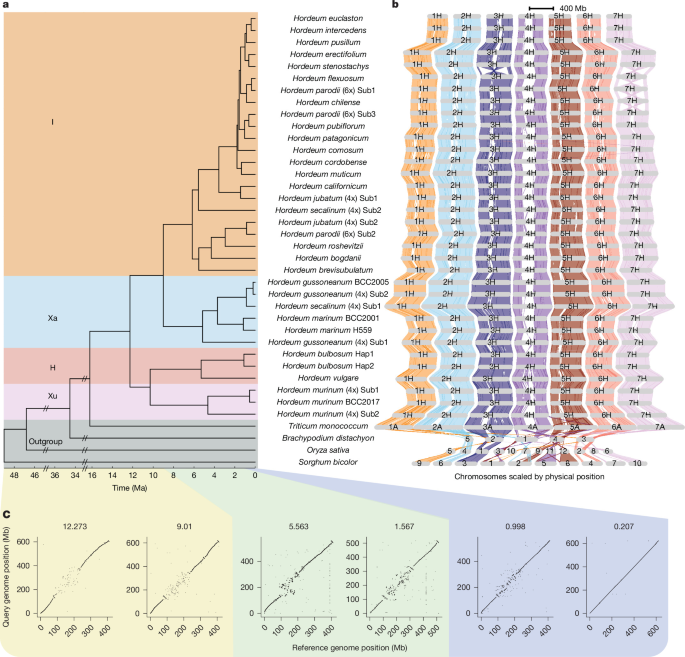
The genus Hordeum comprises approximately 33 species and is widely distributed across the temperate regions of Eurasia and the Americas 1 , 2 , 3 . Hordeum is classified into two subgenera based on cytogenetic evidence: one containing the H and Xu genomes and the other containing the I and Xa genomes 4 . The basic chromosome number is seven, and, although most species are diploid, tetraploid and hexaploid taxa have also been described. Cultivated barley ( Hordeum vulgare ) is the best known and most extensively studied species, as it represents one of the earliest domesticated cereal crops. Today, barley is the world’s fourth most important grain, valued for its use in food, animal feed and brewing 5 . Cultivated barley and its wild progenitor ( H. vulgare subsp. spontaneum ) constitute a single inter-fertile gene pool, allowing for frequent gene flow between wild and cultivated forms 6 . This primary gene pool has long been exploited by breeders to introduce desirable traits 6 .…