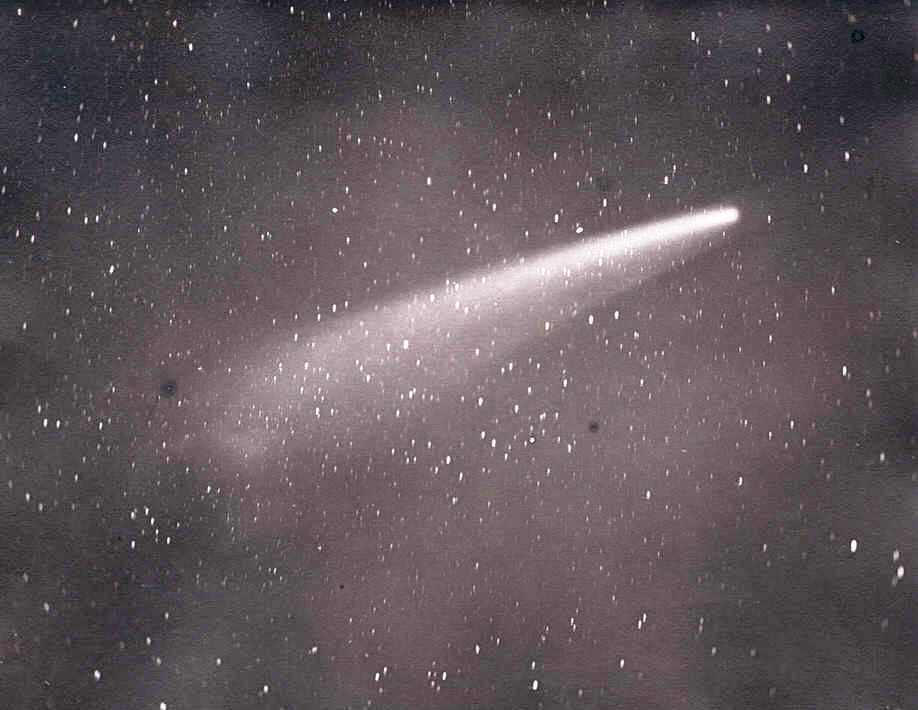
Today in the history of astronomy, David Gill photographs the Great Comet of 1882, revolutionizing star mapping.
| Published: November 7, 2026
David Gill's Nov. 7 photo of the Great Comet of 1882 was a 100-minute exposure. The quantity of stars visible revealed astrophotography's utility for star mapping. Credit: Sir David Gill, 1843-1914, Public domain, via Wikimedia Commons
In early September 1882, a comet was sighted from the Cape of Good Hope in South Africa. The comet brightened over the following weeks, reaching a magnitude of -2 on the 15th; at perihelion two days later, it was bright enough to be visible during the day. But at the time, David Gill, the director of the Cape Observatory, was busy observing minor planets Victoria and Sappho. It wasn’t until Oct. 12 that, his minor planet observations completed, he turned his attention to the comet and began photographing it .
Gill captured images of the Great Comet of 1882 on Oct. 12, 20, and 21, and Nov. 7, 13, and 14. The Nov.…