16 min read
CSS , Coding , Techniques , Tools
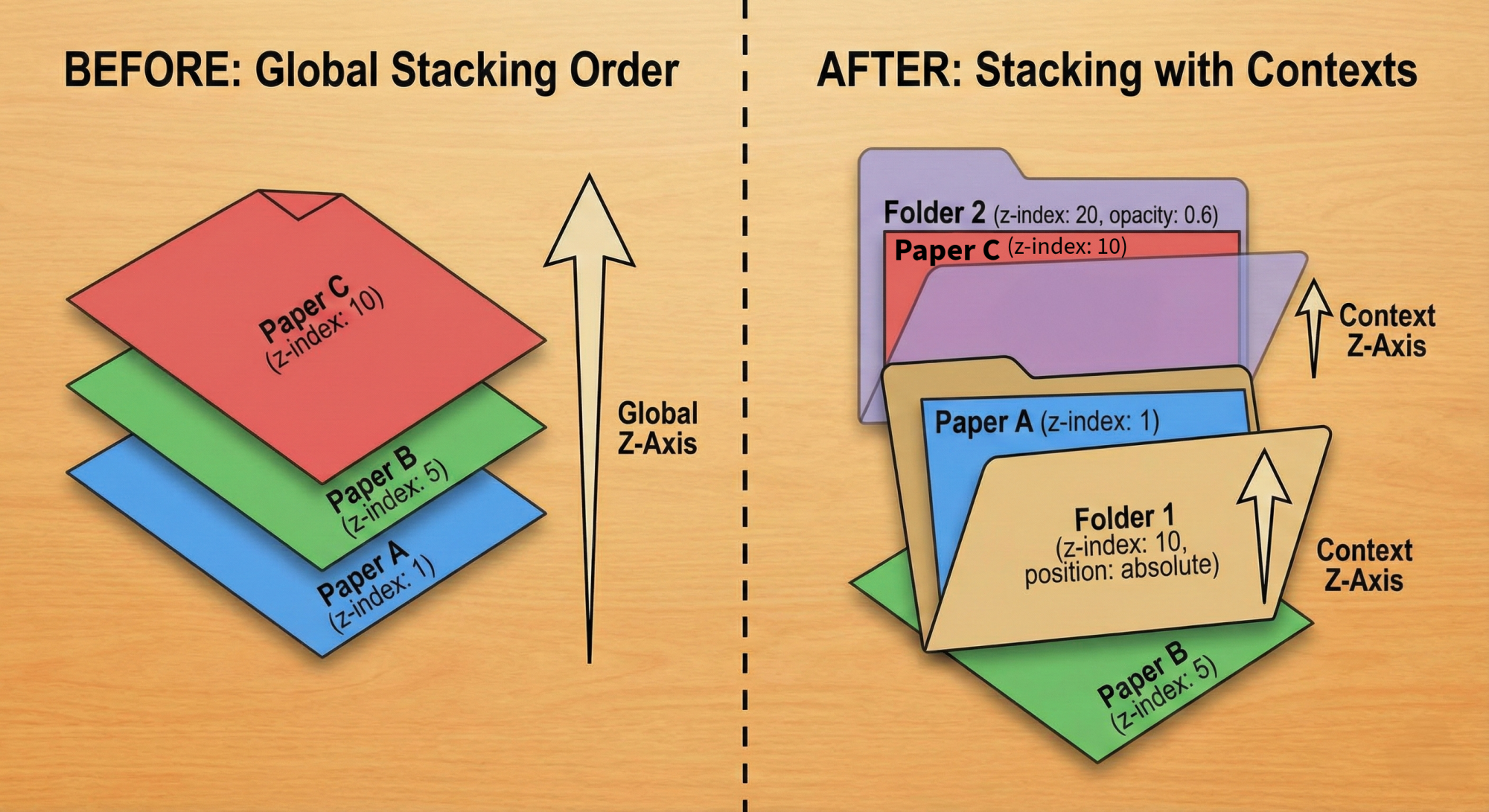
In CSS, we can create “stacking contexts” where elements are visually placed one on top of the next in a three-dimensional sense that creates the perception of depth. Stacking contexts are incredibly useful, but they’re also widely misunderstood and often mistakenly created, leading to a slew of layout issues that can be tricky to solve.
Have you ever set z-index: 99999 on an element in your CSS, and it doesn’t come out on top of other elements? A value that large should easily place that element visually on top of anything else, assuming all the different elements are set at either a lower value or not set at all.
A webpage is usually represented in a two-dimensional space; however, by applying specific CSS properties, an imaginary z-axis plane is introduced to convey depth. This plane is perpendicular to the screen, and from it, the user perceives the order of elements, one on top of the other.…