In 1687, Sir Isaac Newton released his magnum opus, Philosophiæ Naturalis Principia Mathematica (The Mathematical Principles of Natural Philosophy), in which he described his theories of motion and gravity. His theory of the latter accurately described the motion of the Earth's tides, something that scientists had been wrestling with for centuries. For over three hundred years, Newton's work remained scientific canon and the last word on gravity, until Albert Einstein introduced his Theory of General Relativity .
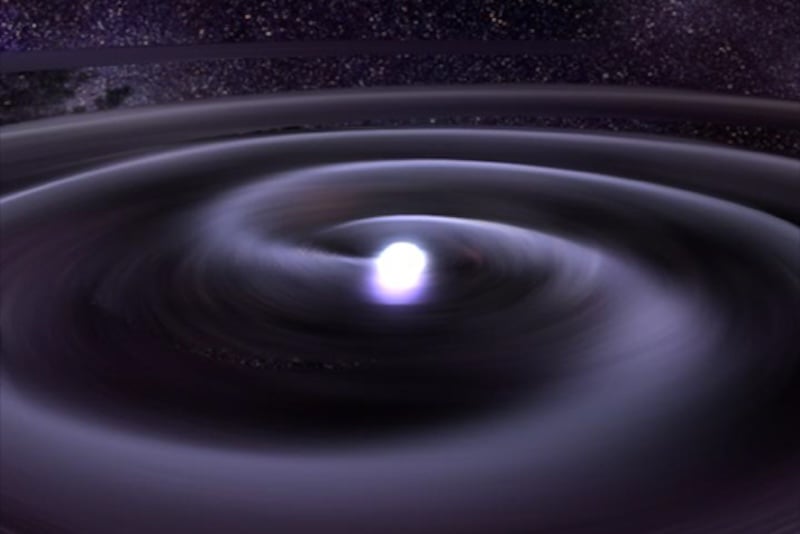
According to a recent study from the Freie Universität Berlin (FUB), some hints of General Relativity (GR) may be buried within Newton's tidal theories. While the pull of the Sun and Moon and their influence on the tides can be predicted very accurately using Newtonian gravity, GR offers a fuller description that includes gravitational waves (GWs).…