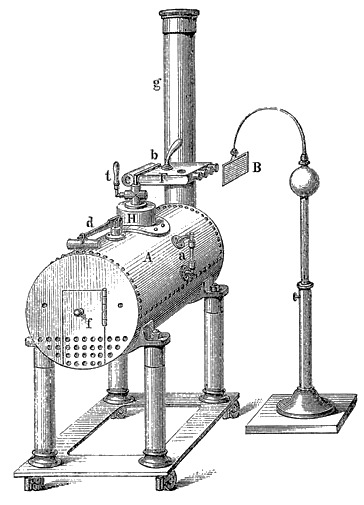
From Wikipedia, the free encyclopedia Armstrong hydroelectric machine The Armstrong effect is the physical process by which static electricity is produced by the friction of a fluid. It was first discovered in 1840 when an electrical spark resulted from water droplets being swept out by escaping steam from a boiler. The effect is named after William Armstrong , who later became 1st Baron Armstrong, who was one of several people involved in discovering the effect and investigating the processes involved. [ 1 ] Using this principle, Armstrong went on to invent what he called the Armstrong hydroelectric machine , which, despite its name, generated static electricity and not hydroelectric power . At Seghill , near Newcastle upon Tyne in northern England, the Cramlingham Colliery railway had a 28-horsepower (21 kW) winding engine to haul the coal wagons. In September 1840, Patterson, the engine driver, noticed a slight leak of steam from beside the safety valve .…