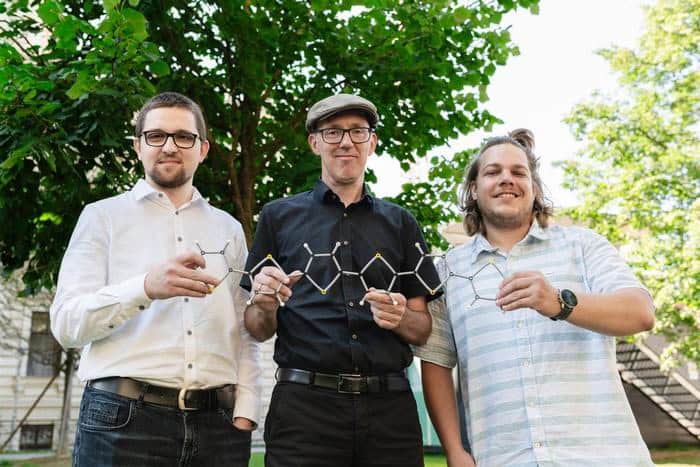
Peter Puschnig (centre) with PhD student Siegfried Kaidisch (left) and postdoctoral researcher Christian Kern from his research group at the University of Graz. (Courtesy: University of Graz / Angele)
Physicists have experimentally reconstructed the quantum probability distribution of an exciton for the first time using super-fast spectroscopy. By simultaneously capturing the spatial and momentum spreads of these short-lived quasiparticles, the work adds to our understanding of how excitons evolve in complex materials. According to members of the research team, this improved understanding could lead to advances in organic photovoltaic devices.
When light shines on materials such as insulators and semiconductors, the energy from these incident photons can sometimes promote electrons in the material to higher energy bands, leaving behind positively charged holes.…