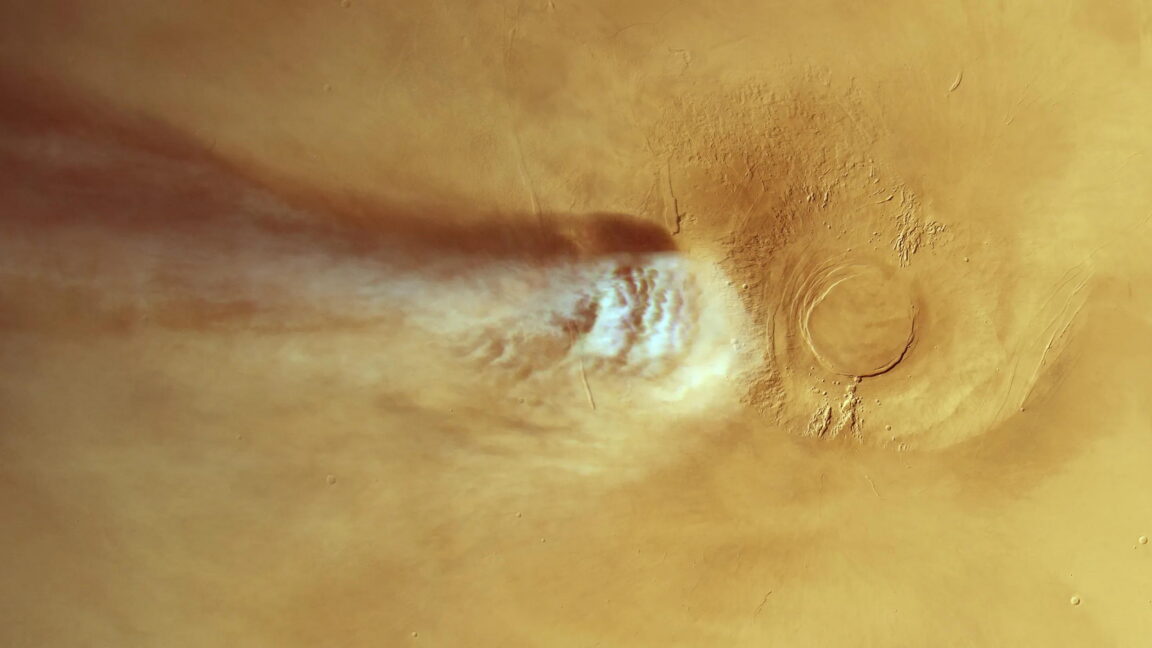
On Earth, clouds usually form when water vapor creates droplets or ice crystals in the presence of tiny particles, such as dust or salt. The new study, published in Nature Geoscience , instead suggests AMEC could be forming through so-called homogeneous nucleation, where vapor changes directly into ice crystals on its own without any help from debris.
“It’s akin to droplets of condensation appearing in the middle of a room, rather than on a window,” Hernández-Bernal explained. “It’s wholly unexpected.”
This phenomenon requires extreme conditions—a sharp temperature drop of 30° Celsius within 10 minutes and high relative humidity. The Arsia Mons volcano also plays a key role. When wind current hits the 65,000-foot-tall volcano , it creates a powerful wave that launches moist air high in the atmosphere in a matter of minutes.
Scientists have assumed a similar phenomenon could occur in the upper atmospheres of other planets, including Venus and even Earth, but it has never been observed .…