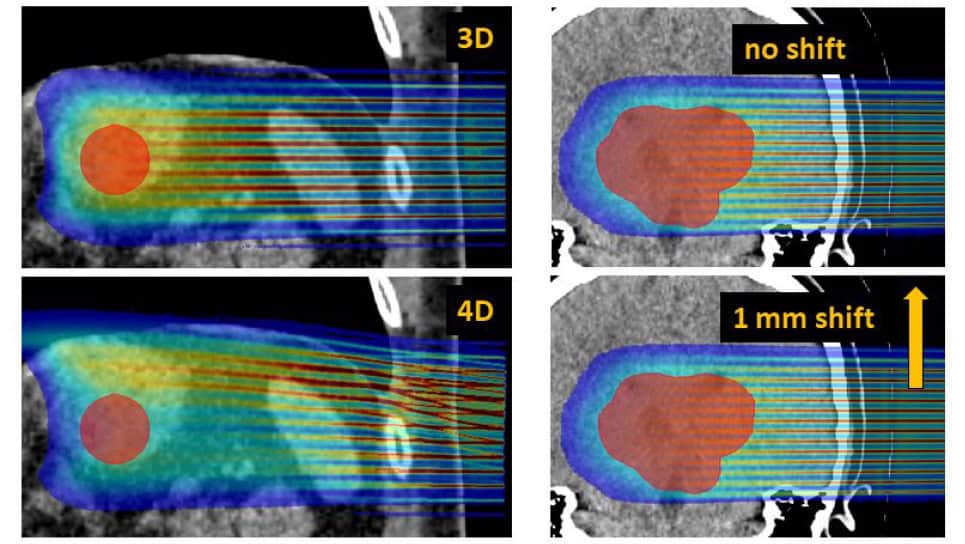
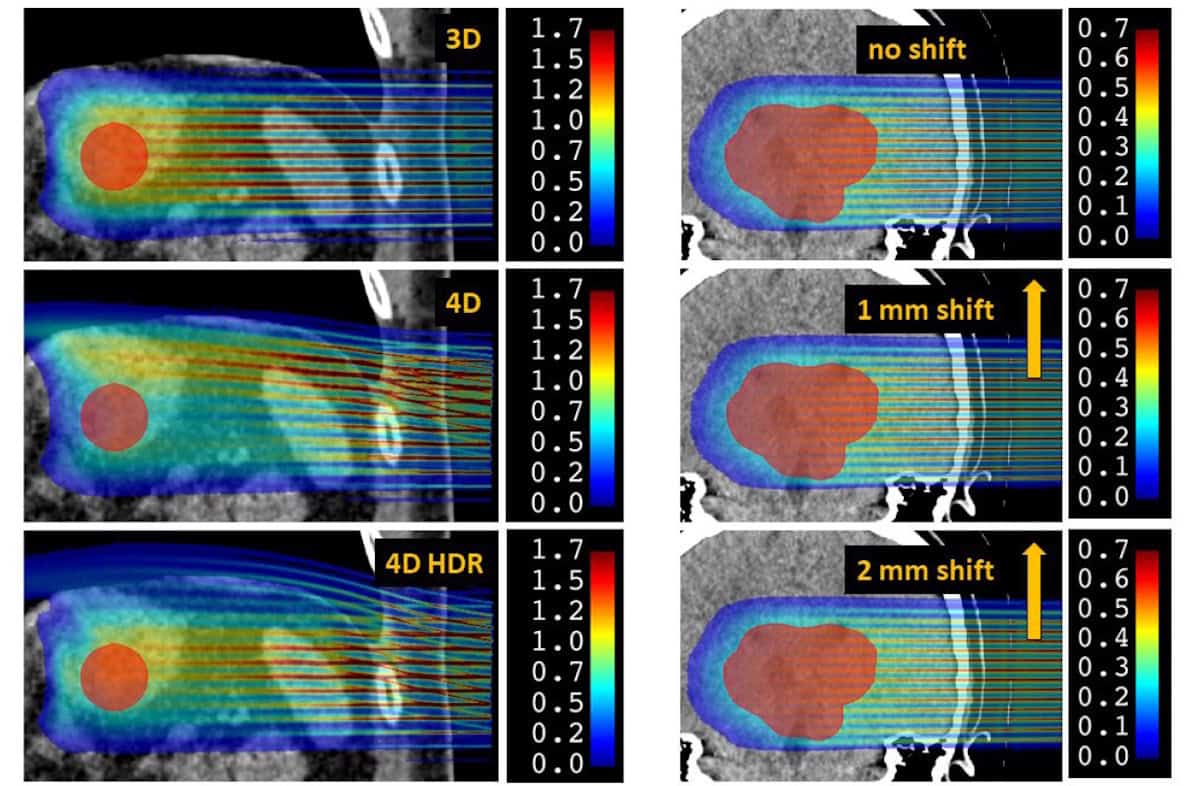
Dose calculations Left: dose distributions for thoracic pMBRT without motion (3D), with respiratory motion (4D) and with respiratory motion at high dose rate (4D-HDR). Right: dose distributions for a brain treatment with zero shift, a 1 mm shift and a 2 mm shift. (Courtesy: Phys. Med. Biol. 10.1088/1361-6560/ae8ef8)" title="Click to open image in popup" href="https://physicsworld.com/wp-content/uploads/2026/08/31-08-26-pmb-minibeam-fig5.jpg"> Dose calculations Left: dose distributions for thoracic pMBRT without motion (3D), with respiratory motion (4D) and with respiratory motion at high dose rate (4D HDR). Right: dose distributions for a brain treatment with zero shift, a 1 mm shift and a 2 mm shift. (Courtesy: Phys. Med. Biol. 10.1088/1361-6560/ae8ef8)
Proton minibeam radiotherapy (pMBRT) is an innovative new cancer treatment that uses an array of narrow proton beams to create alternating regions of high and low dose, before converging to a homogeneous dose distribution within the target volume.…