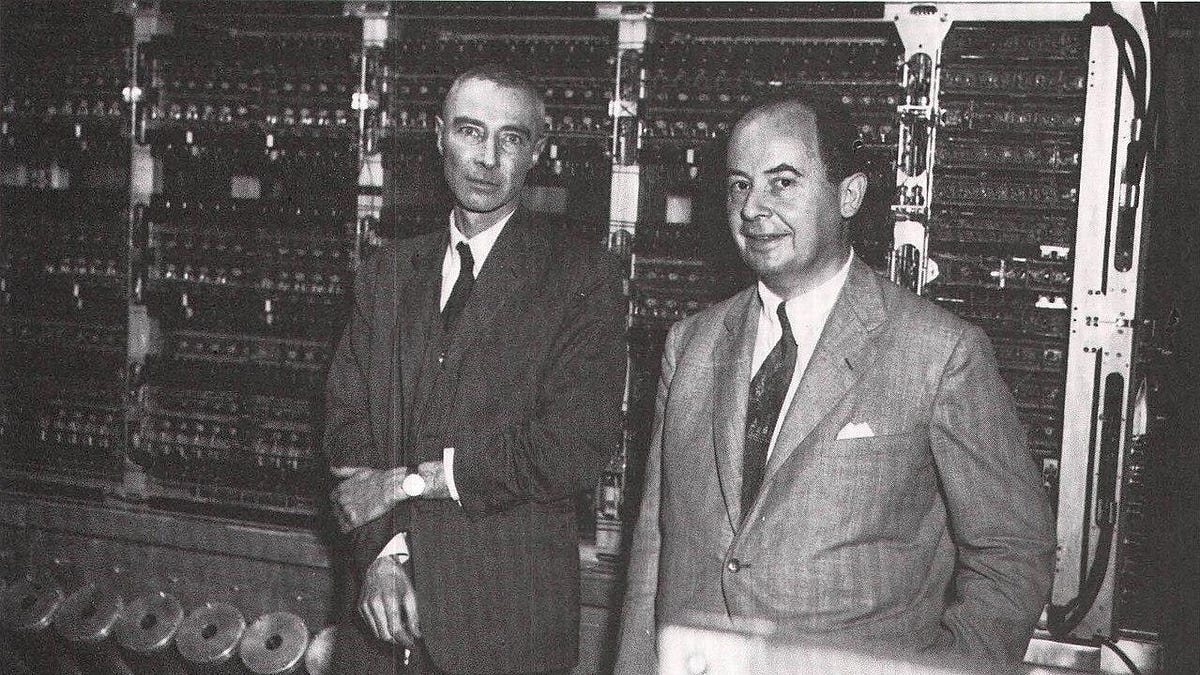
At the 1952 dedication of the Institute for Advanced Study computer. AI may be less like an electronic Einstein than a machine-amplified von Neumann: immense speed, breadth and symbolic memory. When an AI system solves a difficult mathematical problem, the usual explanation is that it has become more intelligent. Perhaps it has absorbed millions of mathematical examples. Perhaps reinforcement learning has taught it better reasoning strategies. Perhaps it is beginning to develop something resembling genuine mathematical intuition. All of these explanations may contain some truth. But they overlook a simpler possibility: AI has access to a vastly larger working memory than the human brain. Or, more precisely, it has access to an enormous external symbolic workspace that performs many of the functions that working memory performs in humans. This difference may be especially important in mathematics. A human mathematician can hold only a small number of unfamiliar elements in mind simultaneously.…