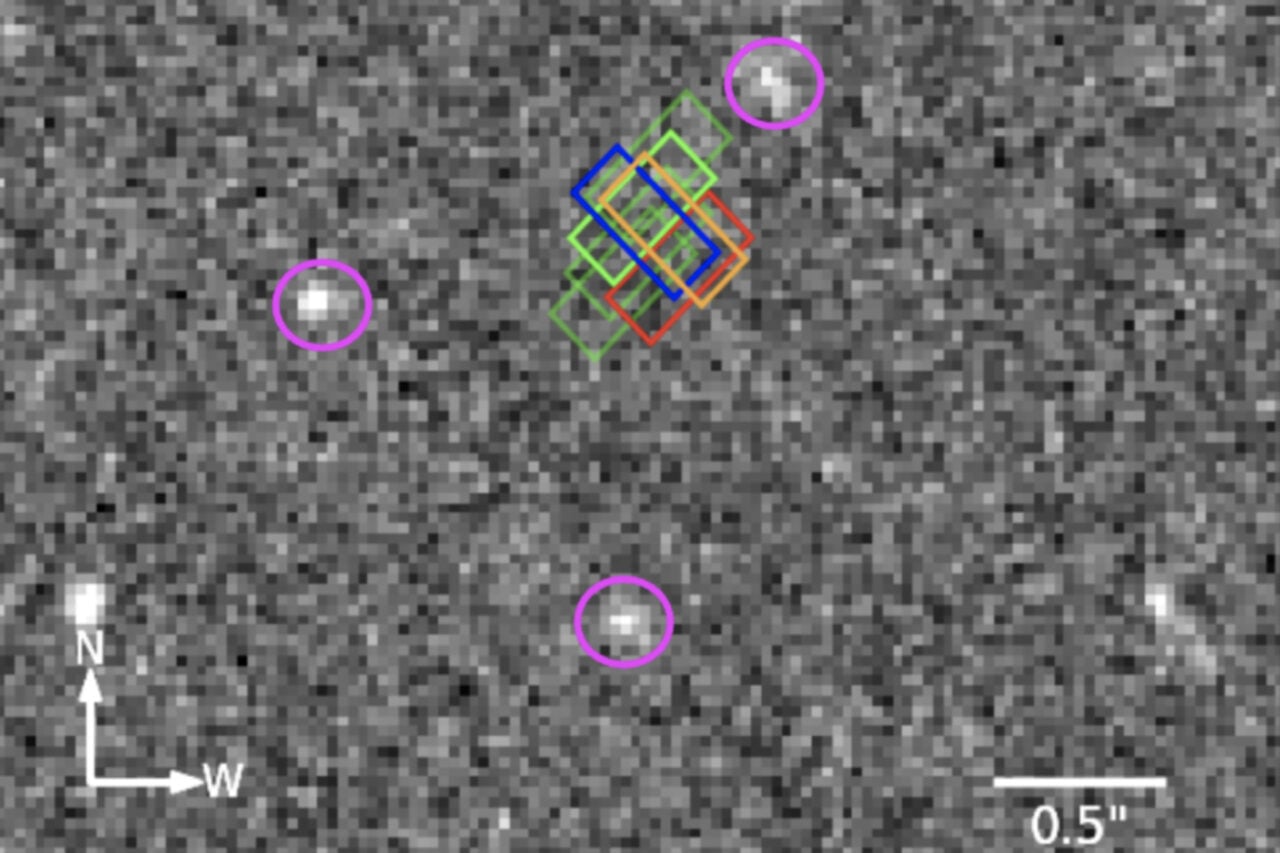
A team of astronomers scouring the distant universe for ancient objects that formed shortly after the Big Bang stumbled upon an unexpected discovery: a single emission line coming from an unidentified source.
Using the Webb space telescope, scientists detected the unusual glow in a seemingly empty patch of the sky in the southern constellation of Fornax. The light appeared twice over the course of three months, despite earlier observations by both Webb and the Hubble space telescope showing no visible object at that location. Its origin remains a mystery, and the possible candidates aren’t your garden-variety space objects. The findings are detailed in a new paper published in The Astrophysical Journal.
Staring into the void
Astrophysicist Mason Huberty of the University of Minnesota was searching for yet-to-be detected objects. Using Webb’s Near InfraRed Spectrograph, Huberty and his team blocked light from known objects such as galaxies that had been previously identified by Hubble.…