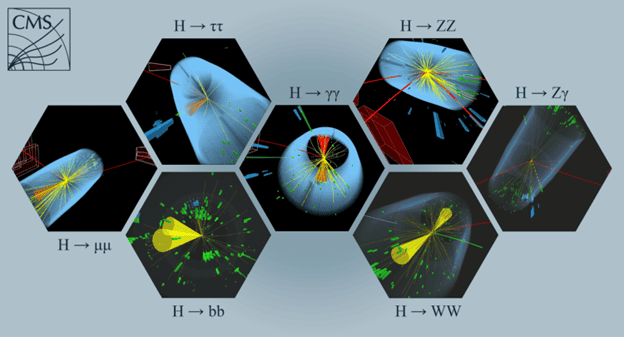
The largest combined study of Higgs boson production and decay to date using data from the CMS experiment finds no significant deviations from theory
Abstract light burst (Courtesy: Shutterstock/Serg DAV)
The Higgs boson is associated with the Higgs field, which gives many fundamental particles their mass. Although it was predicted in the 1960s, it was not discovered until 2012. Since then, researchers have been studying whether the Higgs behaves exactly as predicted by the Standard Model of particle physics or whether it shows signs of physics beyond the Standard Model. This involves measuring how often Higgs bosons are produced, how they are produced, what they decay into, and how they interact with other particles.
In this work, the researchers combined measurements from proton-proton collisions recorded between 2016 and 2018 by the CMS experiment. These collisions can produce Higgs bosons, but such events are rare, so a huge dataset was needed.…