Menu

1 / 2

Missing decay at BESIII points to long-sought glueball – Physics World

Reading 0:00
15s threshold

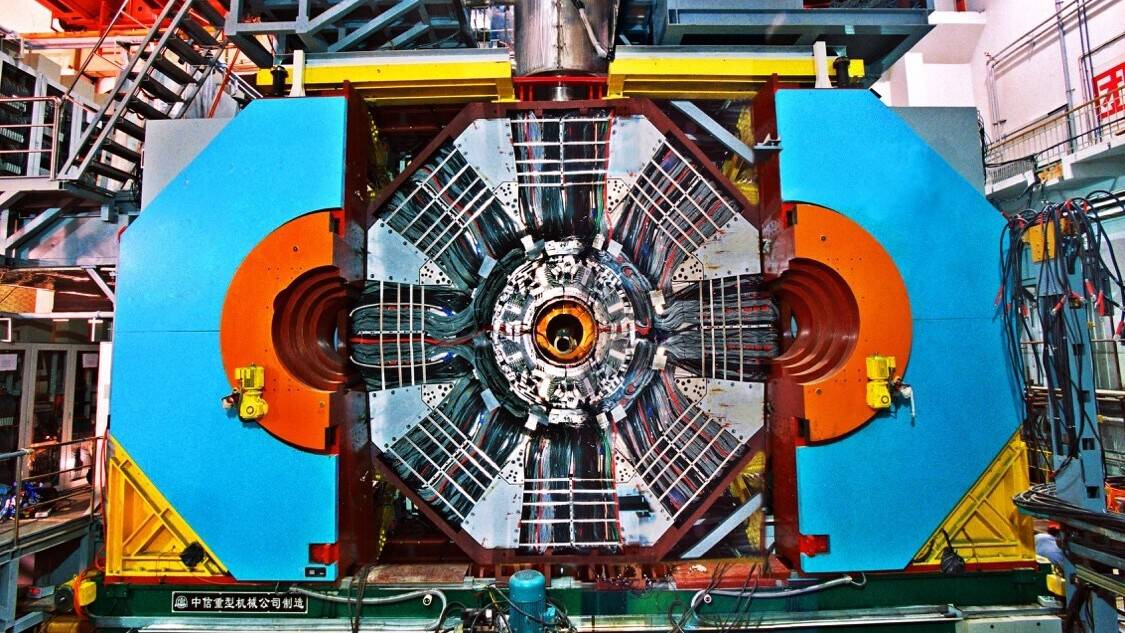
Searching for glueballs China’s BESIII detector has found strong evidence that gluons can clump together to form a quark-and-lepton-free particle. (Courtesy: Institute of High Energy Physics)"> Searching for glueballs China’s BESIII detector has found strong evidence that gluons can clump together to form a quark-and-lepton-free particle. (Courtesy: Institute of High Energy Physics)

Physicists at China’s BESIII experiment in Beijing have found the strongest evidence yet for the existence of glueballs – subatomic particles made of gluons alone. The glueball-like particle is called X(2370) and it was first spotted at BESIII 15 years ago.

Gluons carry the strong nuclear force that binds quarks into protons and neutrons.…

Continue reading — create a free account

Join HashtagPLUS to read full articles, follow hashtags, vote, and join the conversation.