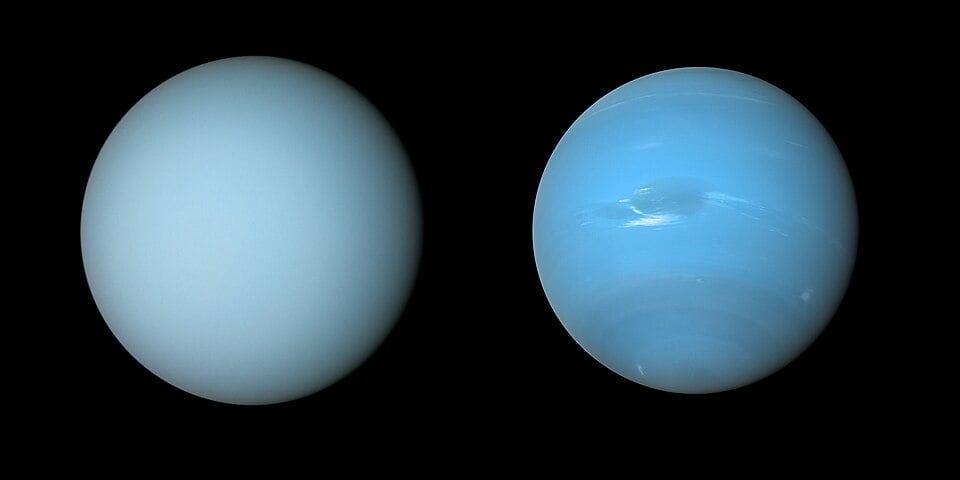
For decades, astronomers have divided the planets in the outer solar system into two distinct camps. Jupiter and Saturn were the “gas giants” made up primarily of hydrogen and helium. Uranus and Neptune were the “ice giants”, and were much smaller but were packed with heavier elements. A new paper from Olivier Mousis of the Southwest Research Institute and his co-authors, available in The Planetary Science Journal, explores whether we can use an isotope of a noble gas - argon-40 - to determine whether there are hidden mountains of rock under the ice giant’s thick atmospheres.
Scientists are getting excited because there has been an ongoing debate that these distant worlds are actually covered in rock. But we can’t simply fly a probe out a few billion miles and drill down into their surfaces to determine that for ourselves.…