Scientific estimates show that there should be between about 100 million and 1 billion stellar-mass black holes in the Milky Way. But they aren't easy to locate. They're not like supermassive black holes (SMBH) at the center of galaxies. Those are usually easy to spot for different reasons.
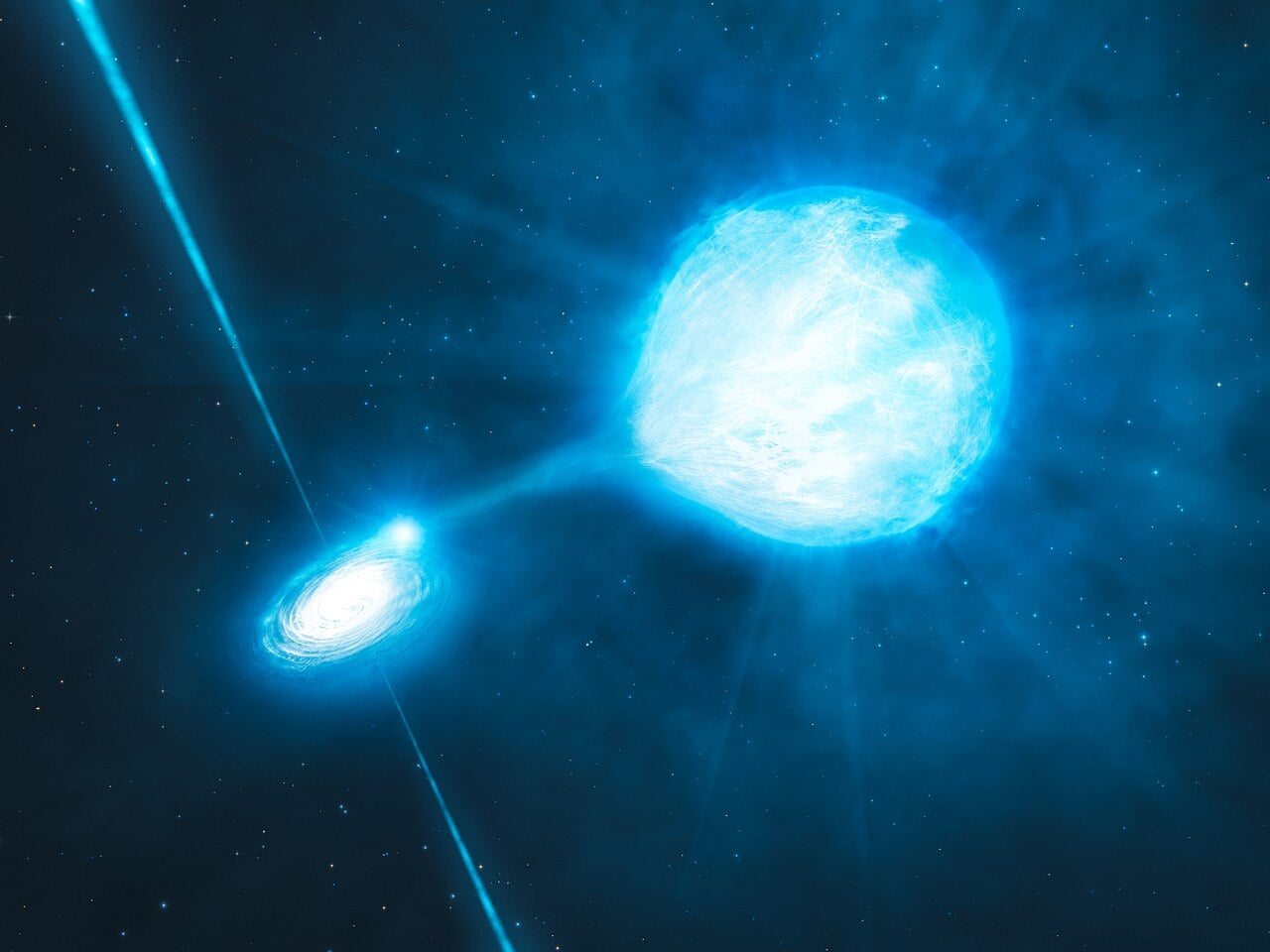
When a SMBH is actively accreting material, the material gathers in a rotating accretion ring, where it heats up and emits energetic radiation. These are called active galactic nuclei (AGN). The brightest of them are called quasars, and they can be seen from vast distances. AGN and quasars emit a pair of powerful astrophysical jets opposite thei axis of rotations, and in some cases these are pointed straight at Earth. We call these blazars, and they announce their presence with a lighthouse-like beam of energy that can't be missed.
Other SMBH are found by their powerful gravity and the effect it has on their surroundings. Sgr A*, the Milky Way's SMBH, is a quiescent black hole that feeds on only a trickle of matter.…