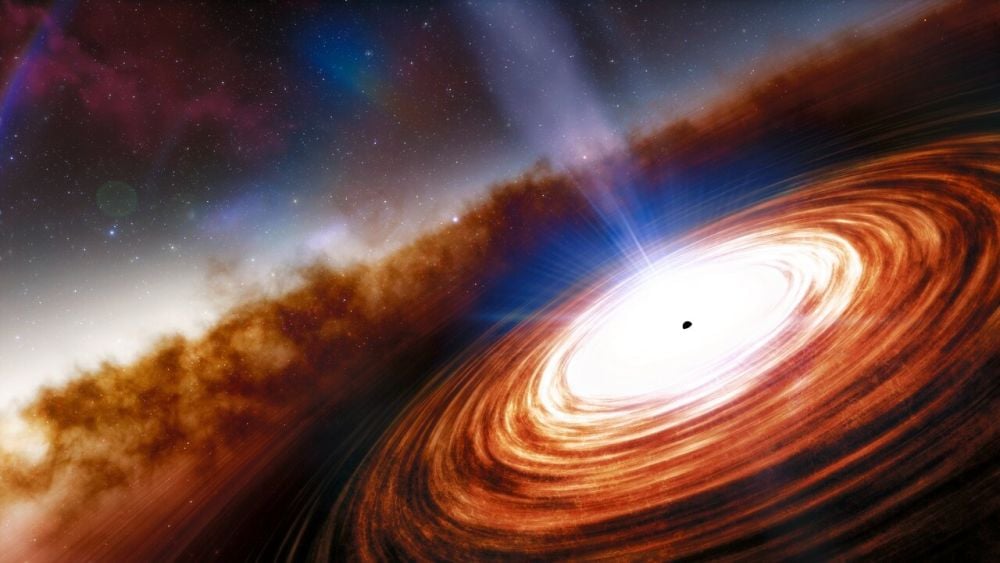
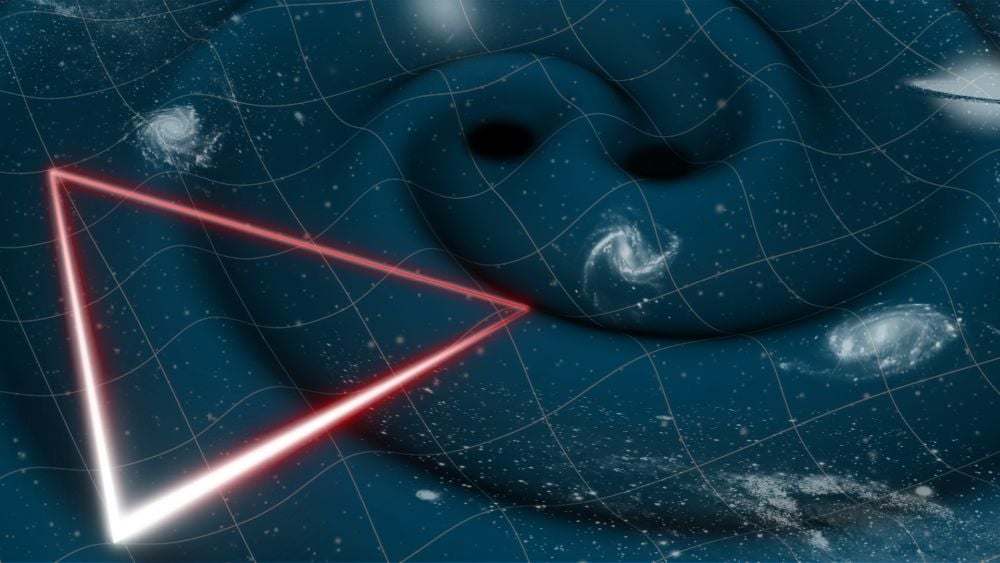
There's ample evidence that large galaxies host supermassive black holes (SMBH) in their centers. And there's growing evidence from gravitational wave detectors that these SMBH merge when their galaxies merge. But astronomers think that sometimes they don't merge, and these are called recoiling SMBH.
A merger takes a long time, and in its final moments, powerful gravitational waves are released. Theoretical predictions state that if the waves aren't emitted equally in all directions—or aren't isometric—the imbalance can drive the merger remnant SMBH away from the galactic center with a powerful kick. This SMBH doesn't leave the galaxy entirely. Instead, it acquires a pendulum-like motion, swinging back and forth, oscillating across the galactic center.
Critically, an SMBH merger remnant like this doesn't have a constant speed. Instead, it moves fastest near the galactic center, and slows at the other end of its swing.…