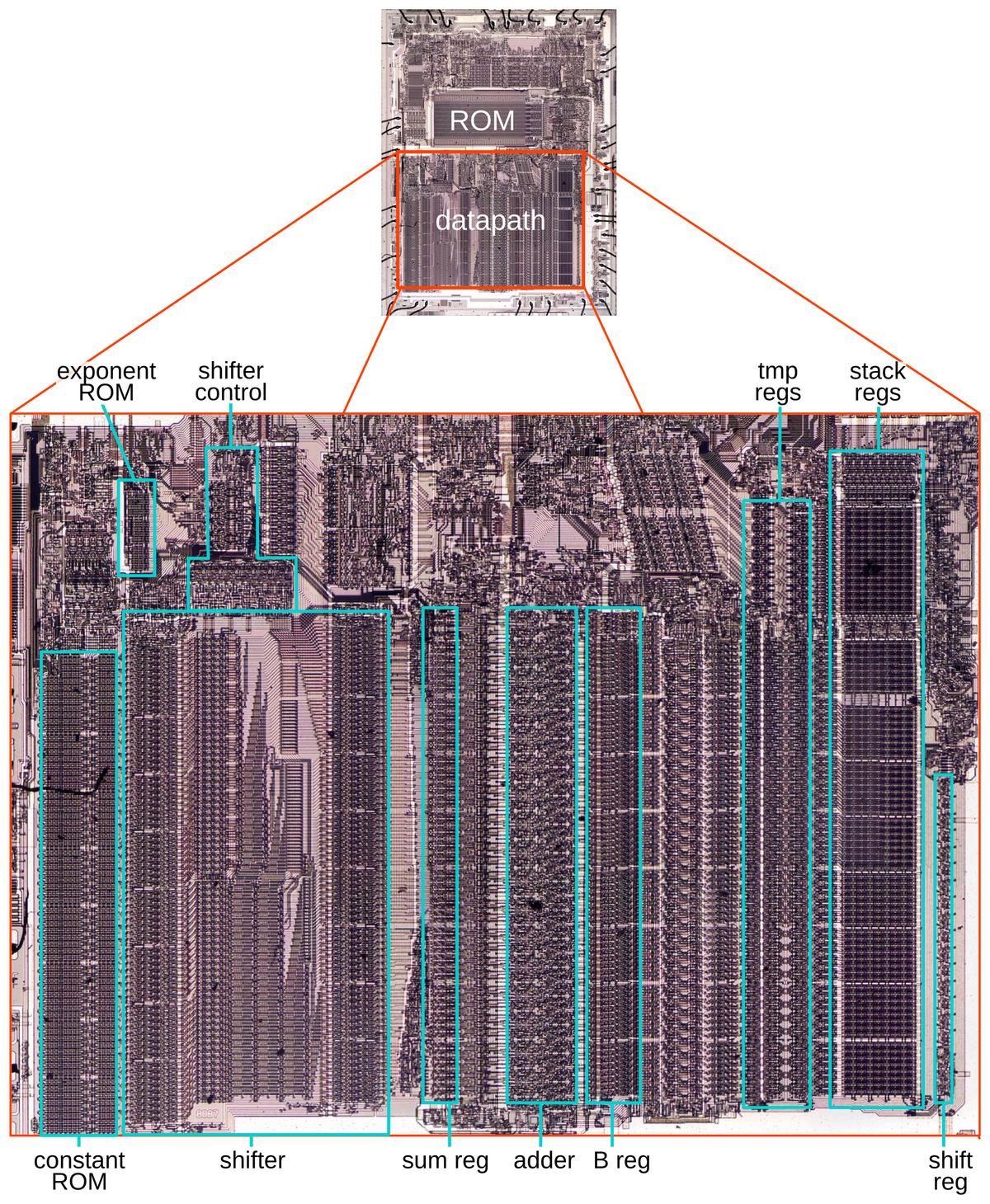
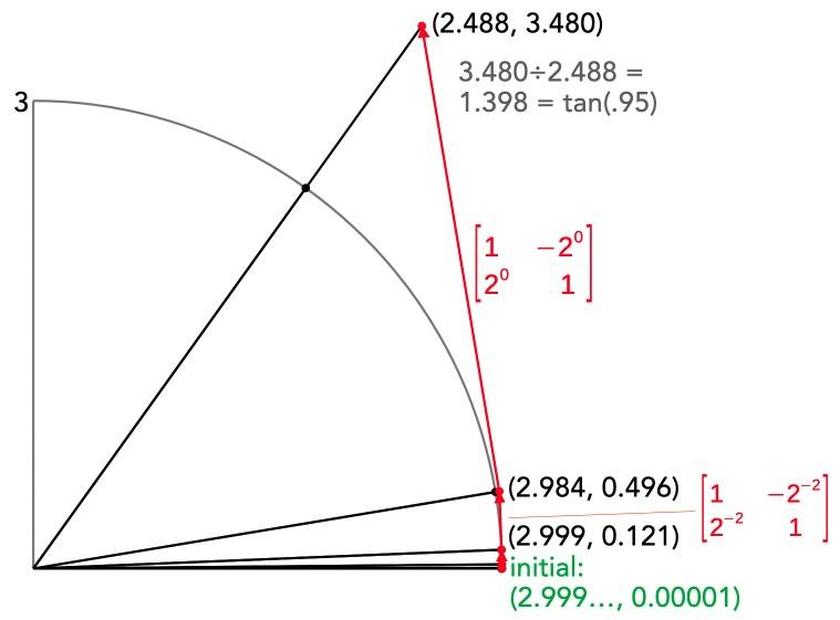
I hope you're not tired of the 8087, because I have another article about Intel's floating-point chip. 1 In 1980, Intel introduced the 8087, making floating-point operations much faster in the IBM PC and other systems. In this article, I look at the algorithm behind the chip's tangent instruction. One popular approach for trigonometric functions is an algorithm called CORDIC. Another approach is a polynomial approximation. The 8087 combined the two to obtain both high accuracy and high performance. The 8087 provided an enormous speedup over the 8086 microprocessor, computing a tangent in 90 microseconds rather than 13,000 microseconds. 2
By examining the circuitry and microcode of the 8087, I can explain the algorithm behind the tangent instruction, called FPTAN . To explore the 8087's circuitry, I popped the lid off a chip with a chisel and created a high-resolution image with a microscope.…