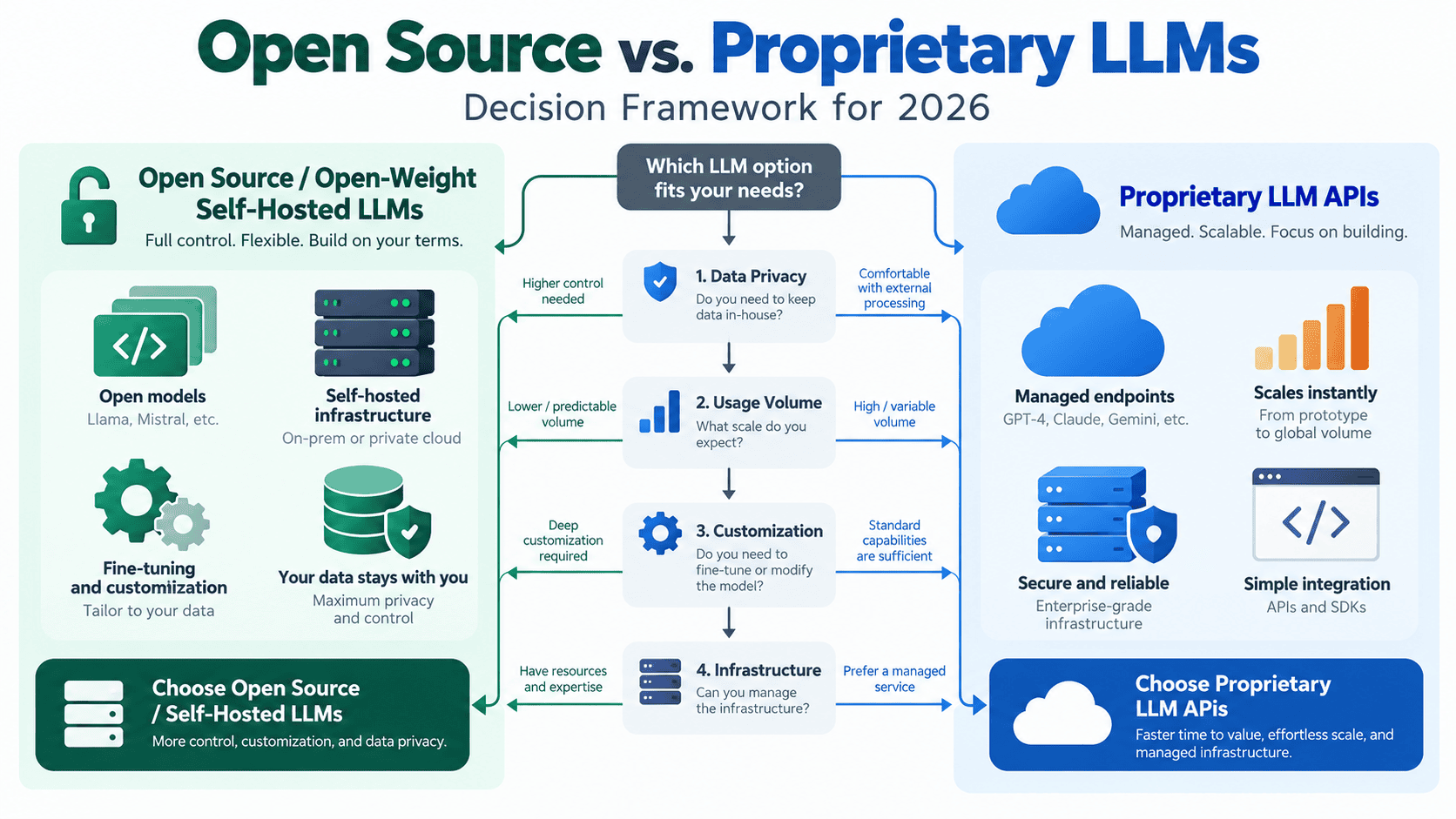
"Should we use an open source or proprietary large language model (LLM)?" The answer in 2026 looks very different from what it did eighteen months ago. The capability gap between the two categories has shrunk considerably. Cost dynamics now favor open models at scale but still tilt toward proprietary APIs for low-volume work and rapid iteration. And the practical factors — data privacy, fine-tuning needs, infrastructure capacity, and regulatory compliance — carry more weight than raw benchmark scores in most real-world decisions.
This guide doesn't argue for one category over the other. Both are legitimate, and both are widely deployed in production. The goal is to give data scientists and machine learning engineers a structured framework for making the decision based on what actually matters for their situation, not what generates the most online commentary.
The framework boils down to four questions: What does your data sensitivity require? What's your usage volume?…