Main
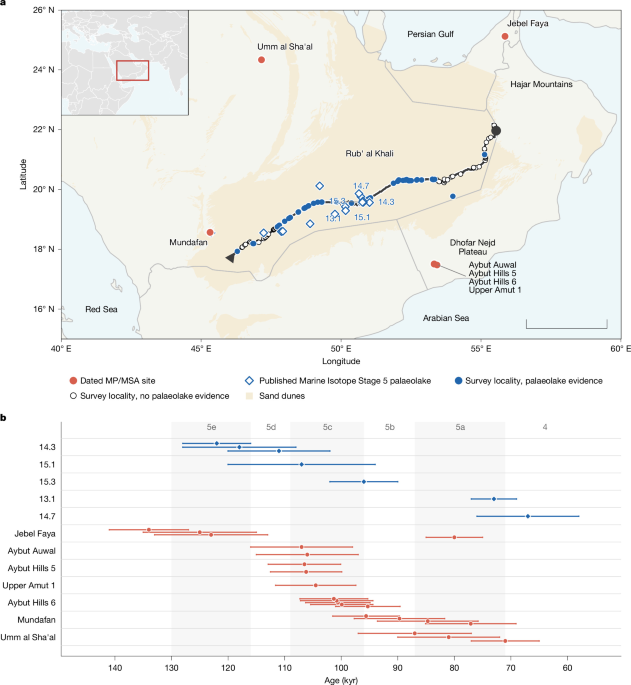
Predictive models of early human dispersal across Arabia, built primarily on palaeohydrological reconstructions of palaeolake and palaeoriver networks and on climate-envelope reconstructions of precipitation and net primary productivity, identify interior basins as high-probability zones for Middle Palaeolithic (MP) and Middle Stone Age (MSA) occupation 3 , 6 , the broadly contemporaneous prepared-core industries of western Eurasia and Africa, respectively; because Arabian assemblages show affinities with both, the joint term MP/MSA is used throughout. The expectation that these palaeolakes attracted human settlement reflects decades of palaeoclimatic research demonstrating that orbital forcing periodically transformed the Arabian Peninsula into landscapes of lakes, wetlands and grasslands 7 , 8 , 9 .…