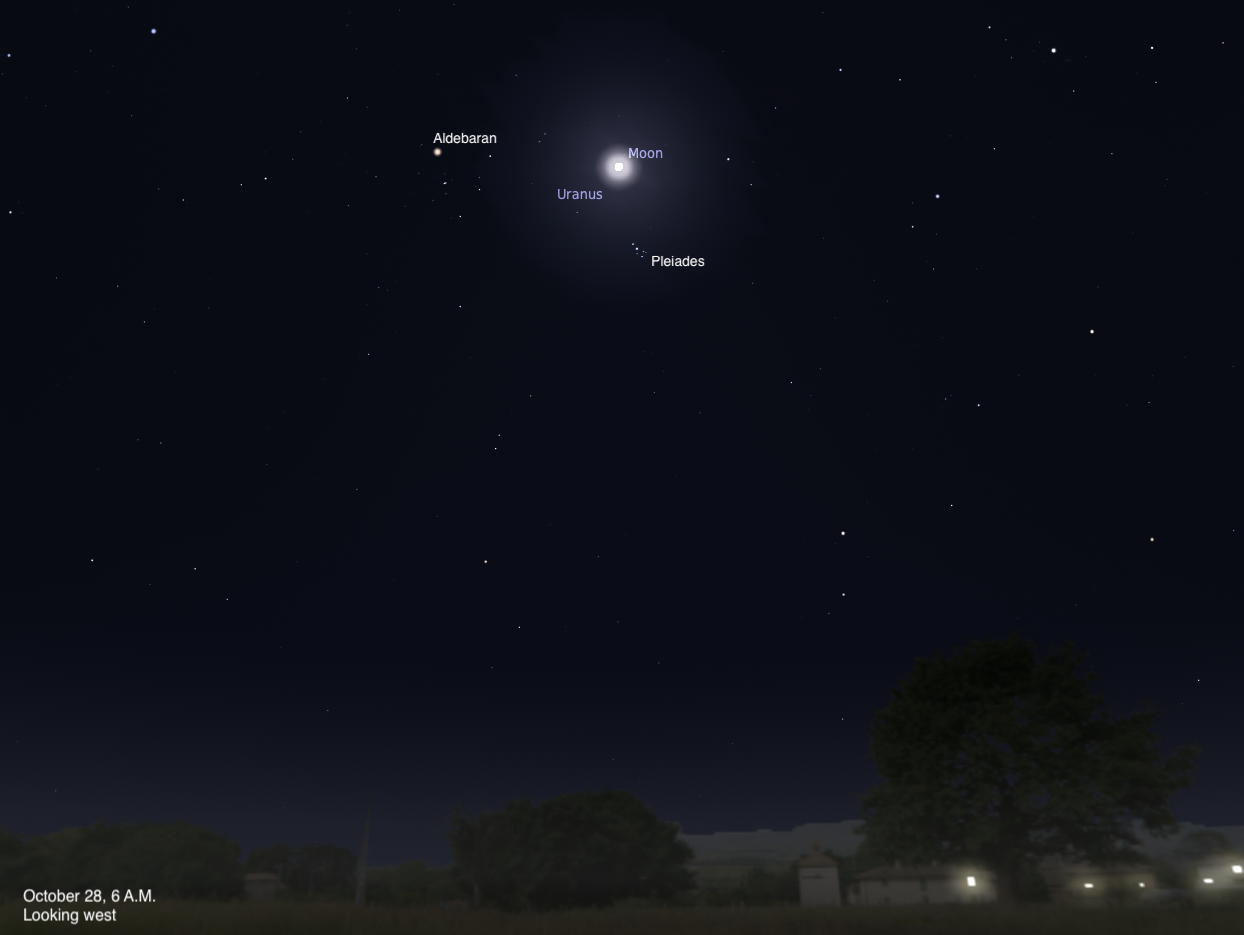
Even with a bright Moon in the sky, you can easily trace this “waterfall” of stars to its end in the spray of open cluster NGC 1502.
| Published: October 27, 2026
Looking for a sky event this week? Check out our full Sky This Week column.
October 26: Observe the October Hunter’s Moon
The Moon’s bright light washes out dimmer targets, but not all deep-sky objects are out of reach. Late this evening, the constellation Camelopardalis sits in the north, to the right (east) of the Little Dipper and sandwiched between Cassiopeia and Ursa Major.
In Camelopardalis’ southwestern region is a 6th-magnitude open cluster called NGC 1502. Stretching about 8’ across, this compact group of young stars lies about 9° south of magnitude 4.6 Gamma (γ) Camelopardalis and is visible in binoculars or any telescope. But it’s only the beginning: NGC 1502 lies at one end of a line of stars known as Kemble’s Cascade. This asterism resembles a waterfall with NGC 1502 serving as the spray of water coming from the pool at its base.…