Main
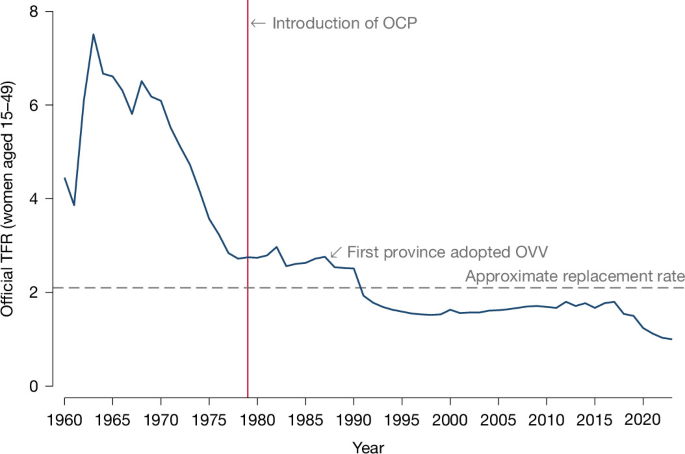
The one-child policy (OCP) is widely considered to be one of the most stringent public policies in modern global history 11 . However, China’s total fertility rate (TFR) declined very little following its implementation in 1979–1980 (Fig. 1 ). Although some past research suggests that the OCP effectively reduced fertility rates 8 , 12 , the policy’s rapid implementation across the country also makes disentangling its impact from secular fertility trends difficult. If the policy were in fact effective, China’s modest gradual decline in fertility throughout the 1980s implies that early enforcement was, at best, weak (Supplementary Note 1 ).
Fig. 1: China’s TFR, 1960–2023. China’s TFR, sourced from the World Population Prospects 2024 by the UN Population Division 62 . The replacement rate is the fertility rate needed for a population to exactly reproduce itself from one generation to the next (without migration).…