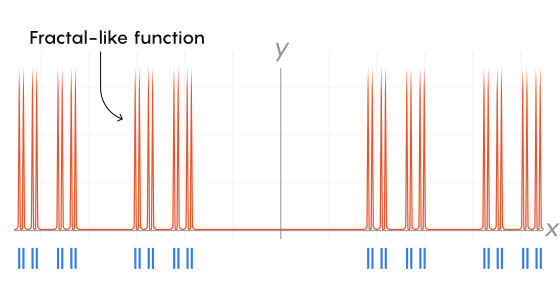
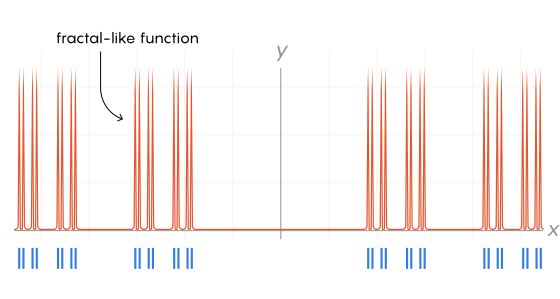
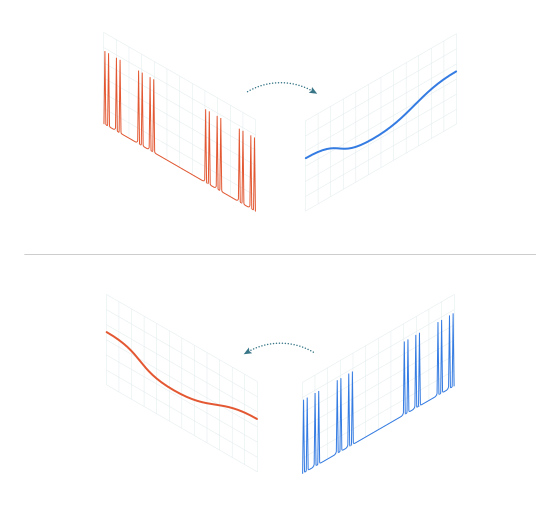
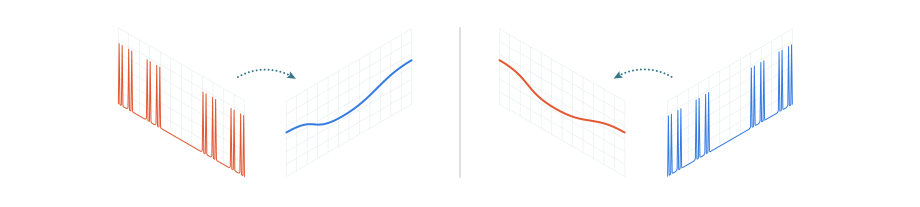
Graduate Student Proves a Quantum Uncertainty Principle for Fractals The math, which combines chaos, quantum theory, and infinitely complex fractal structures, has been called a “foundational result.” Ada Zejun Shen/ Quanta Magazine Introduction A t the quantum scale, tiny particles behave in bizarre ways. One reason for this is the uncertainty principle, which says that the more you know about where a quantum particle is, the less you can know about how fast it’s moving, and vice versa. Recently, this rule got a rare upgrade. The new uncertainty principle relates to fractals, shapes that remain equally complex no matter how much you zoom in on them. Around a decade ago, Semyon Dyatlov , a mathematician at the Massachusetts Institute of Technology, was studying whether quantum particles behave differently than ordinary particles when put into the same chaotic situations. Sometimes, an object moving chaotically can become trapped into following a fractal-like path forever. Could quantum particles do the same?…