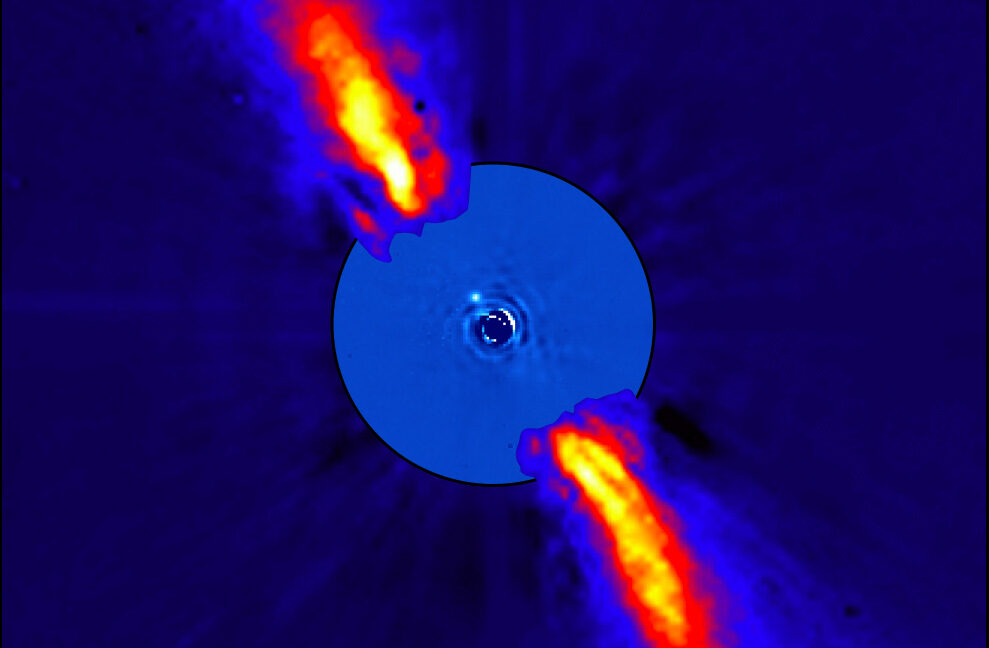
The structure of the water ice also pointed in this direction. When water freezes at moderate temperatures, its molecules settle into an orderly crystal lattice, and crystalline ice produces a sharp peak in the spectrum just above 3 micrometers. That peak was absent at Beta Pictoris. The ice is almost entirely amorphous, a disordered, glass-like solid that forms when water molecules freeze so fast and so cold that they stick wherever they land. The team estimates that less than 7 percent of the water ice in the system is crystalline, which is somewhat surprising.
Models predicted that ice in debris disks should mostly be crystalline. For amorphous ice to stay in that form, it has to remain colder than about 100 Kelvin, or minus 173° Celsius. Otherwise, something has to keep breaking up its crystal structure, such as high-energy ultraviolet light, cosmic rays, or particles streaming from the star.…