Our satellite passes just north of Uranus in Taurus, where there’s plenty to see in the early-morning sky.
| Published: October 28, 2026
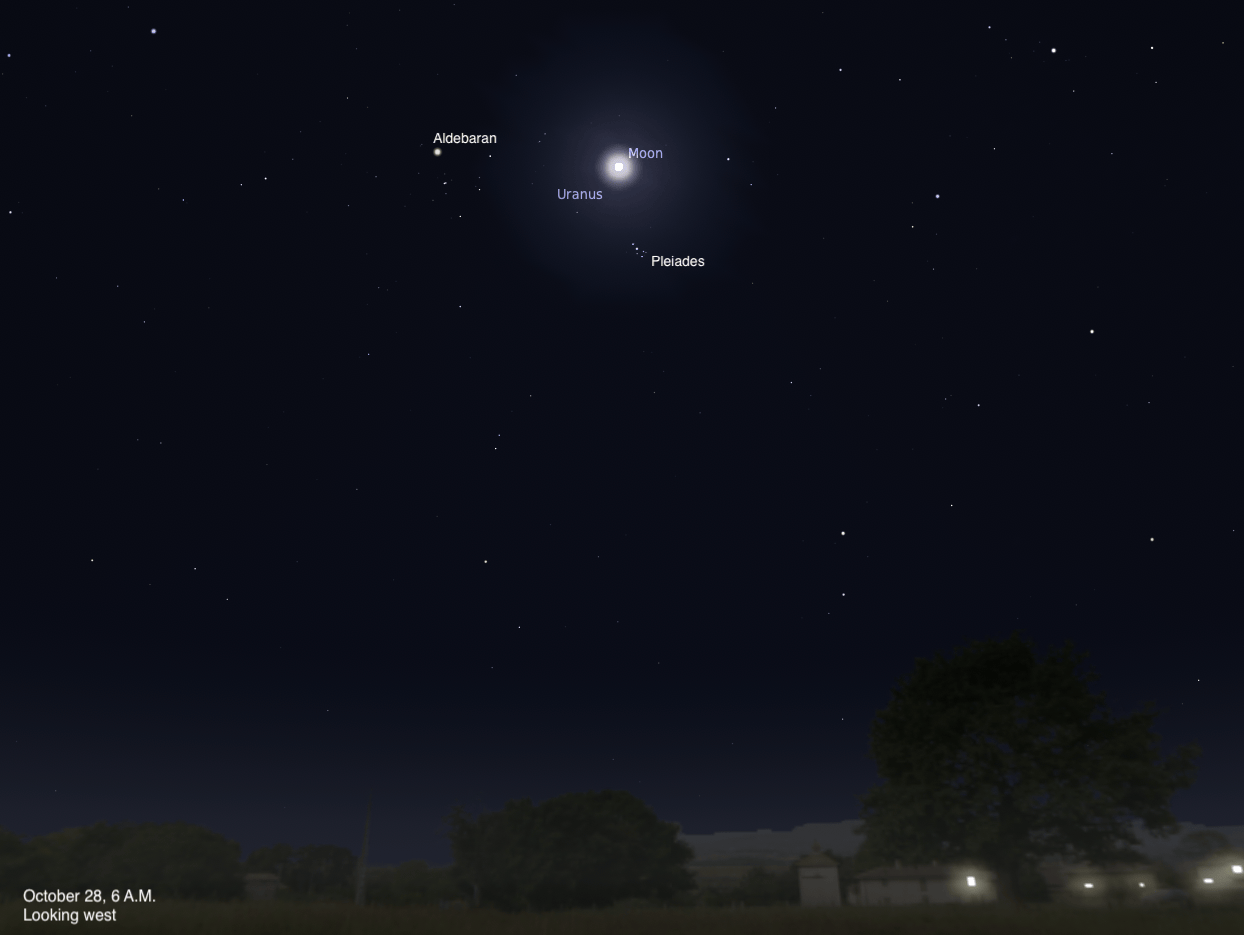
Look west around 6 A.M. local daylight time on the 28th to catch the Moon hanging above the Pleiades star cluster, with Uranus nearby. You’ll likely require binoculars or a telescope to spot the distant planet. Credit: Stellarium/USGS/Celestia/Clementine
Looking for a sky event this week? Check out our full Sky This Week column.
October 27: Follow Kemble’s Cascade
The Moon passes 5° north of Uranus at 6 A.M. EDT this morning. You’ll find our satellite hanging above the Pleiades (M45) in Taurus, roughly 45° high in the west around 6 A.M. local daylight time. Together with Uranus, the Moon and Pleiades form a triangle in the sky that slowly sets as twilight approaches.
If you want to view Uranus, you’ll need some optical aid — technically its magnitude of 5.6 puts it within naked-eye range, but the bright Moon nearby will wash it out.…