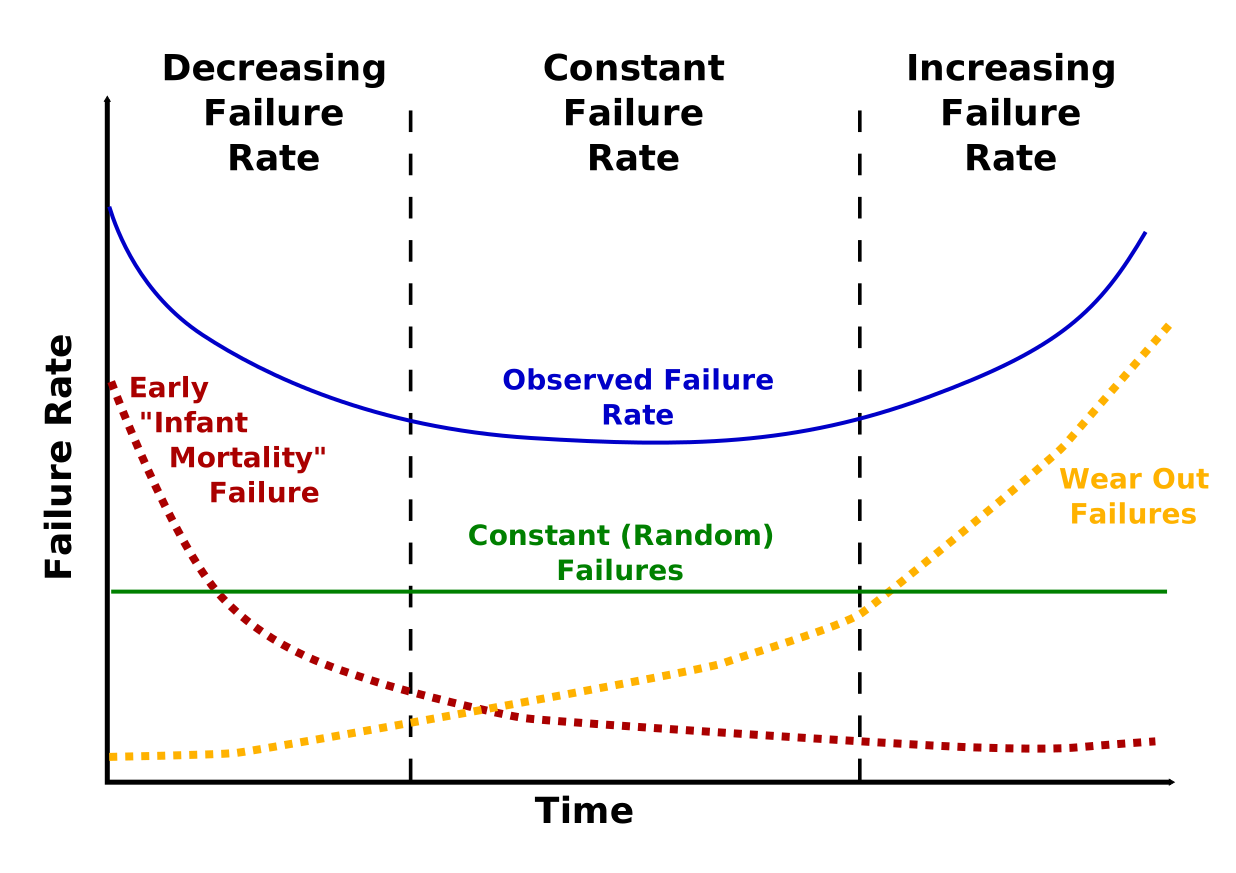
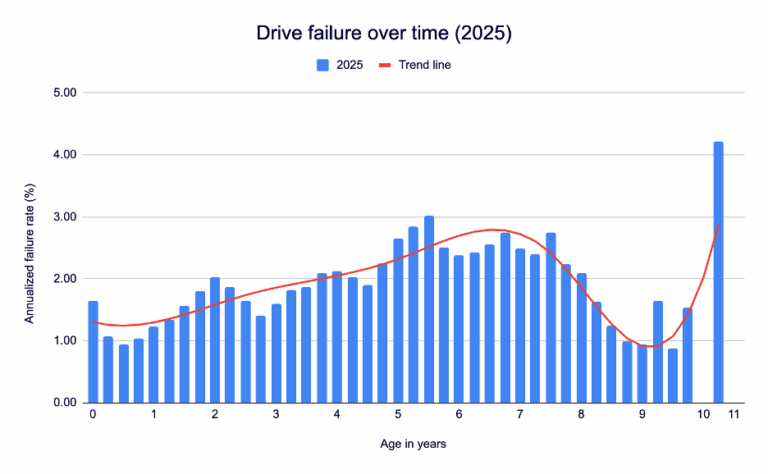
this one's more interesting, because lses are not independent of each other like drive failures are! they are most likely to occur in groups, temporally and spatially close to each other (see above for the approximate distribution). thus, if we encounter one lse on a given drive, we have a decent chance of having have more nearby. hence, we have to take the pmf into account when determining how bad data corruption via lse is. \begin{equation} \label{1411fb31d54e13e11aea72b812891307} \begin{split} & P[k\ \text{drives develop the same LSE in}\ t] \\[0.7em] & = P[\text{one drive develops an LSE in}\ t] \\ & \qquad \cdot \sum_{m = 1}^\infty P[m\ \text{LSEs}\ |\ 1\ \text{LSE}] \cdot P[\text{the rest share}\ \geq 1\ \text{of the}\ m], \\ \end{split} \end{equation} with, if lse events are also Poisson-like, \begin{equation} P[\text{one drive develops an LSE in}\ t] = 1 - \exp\left(-\text{LSE rate} \cdot t\right).…