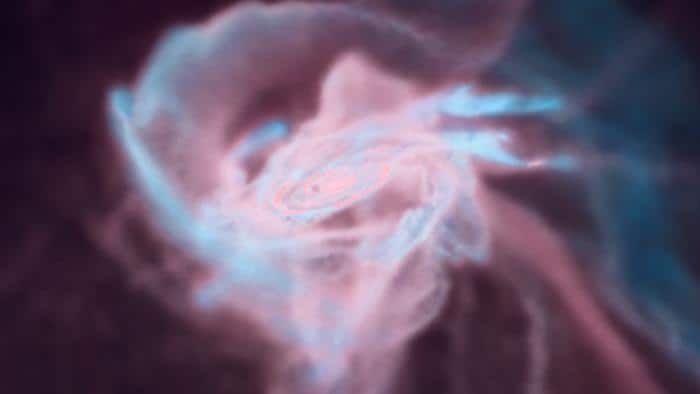
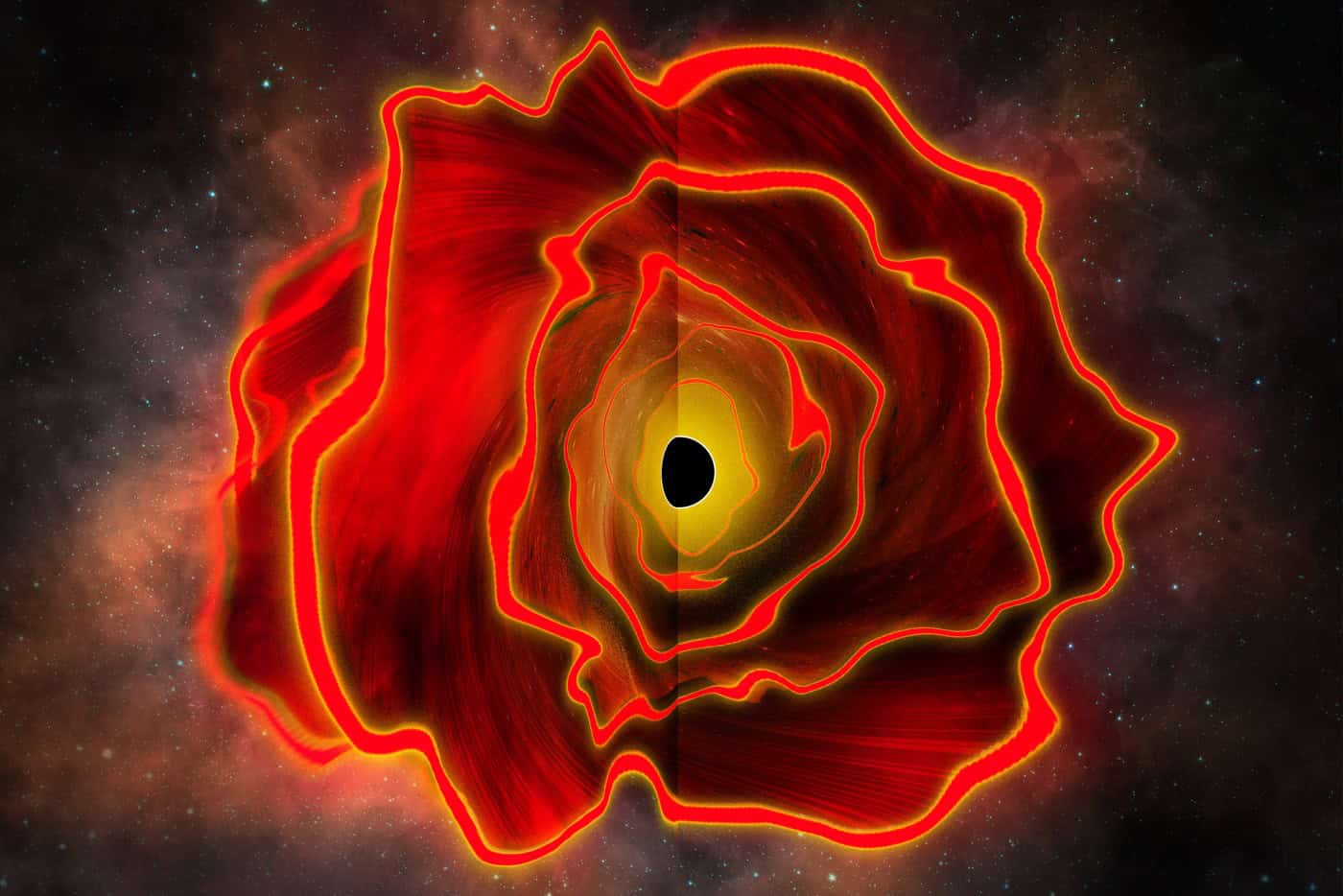
Little red dot? Visualization of the simulation by ATERUI III showing a rapidly growing black hole surrounded by gas. Red indicates areas of higher temperature. (Courtesy: Sunmyon Chon, Takaaki Takeda, 4D2U Project, NAOJ)"> Little red dot? Visualization of the simulation by ATERUI III showing a rapidly growing black hole surrounded by gas. Red indicates areas of higher temperature. (Courtesy: Sunmyon Chon, Takaaki Takeda, 4D2U Project, NAOJ)
Detailed simulations of conditions in the early universe suggest that the mysterious “little red dots” recently observed by the James Webb Space Telescope (JWST) could be young, fast-growing black holes. These simulations, which come from researchers at the Max Planck Institute for Astrophysics in Germany, may resolve a long-standing puzzle concerning how the first supermassive black holes in the universe formed and grew.
Astronomers know that supermassive black holes already existed when the universe was less than one billion years old.…