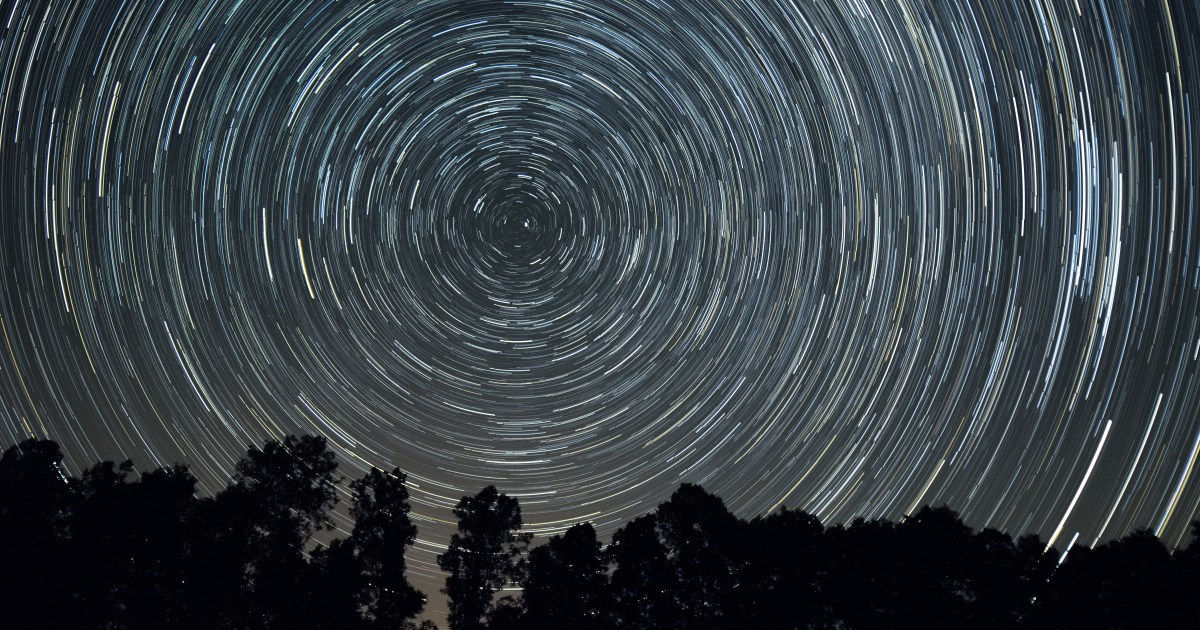
Stars wheel around the North Celestial Pole, as seen from Calhoun County Park, West Virginia. Credit: Molly Wakeling
Just as we use latitude and longitude to know the precise position of something on Earth’s surface, it’s useful to have a system for knowing the position of objects in the heavens. The widely used system of right ascension and declination does the job — and dates back at least to the time of Hipparchus (circa 190–120 b.c.e.).
But one of the hardest parts of getting started in astronomy is comprehending that celestial coordinate system. Rather than looking down at a globe with fixed landmarks, beginners are looking outward to an unfamiliar, ever-shifting sky. So to get an understanding of the celestial sphere, let’s compare to Earth.
On Earth, latitude describes the distance north and south of the equator, in degrees of a circle, from 0 to 90.…