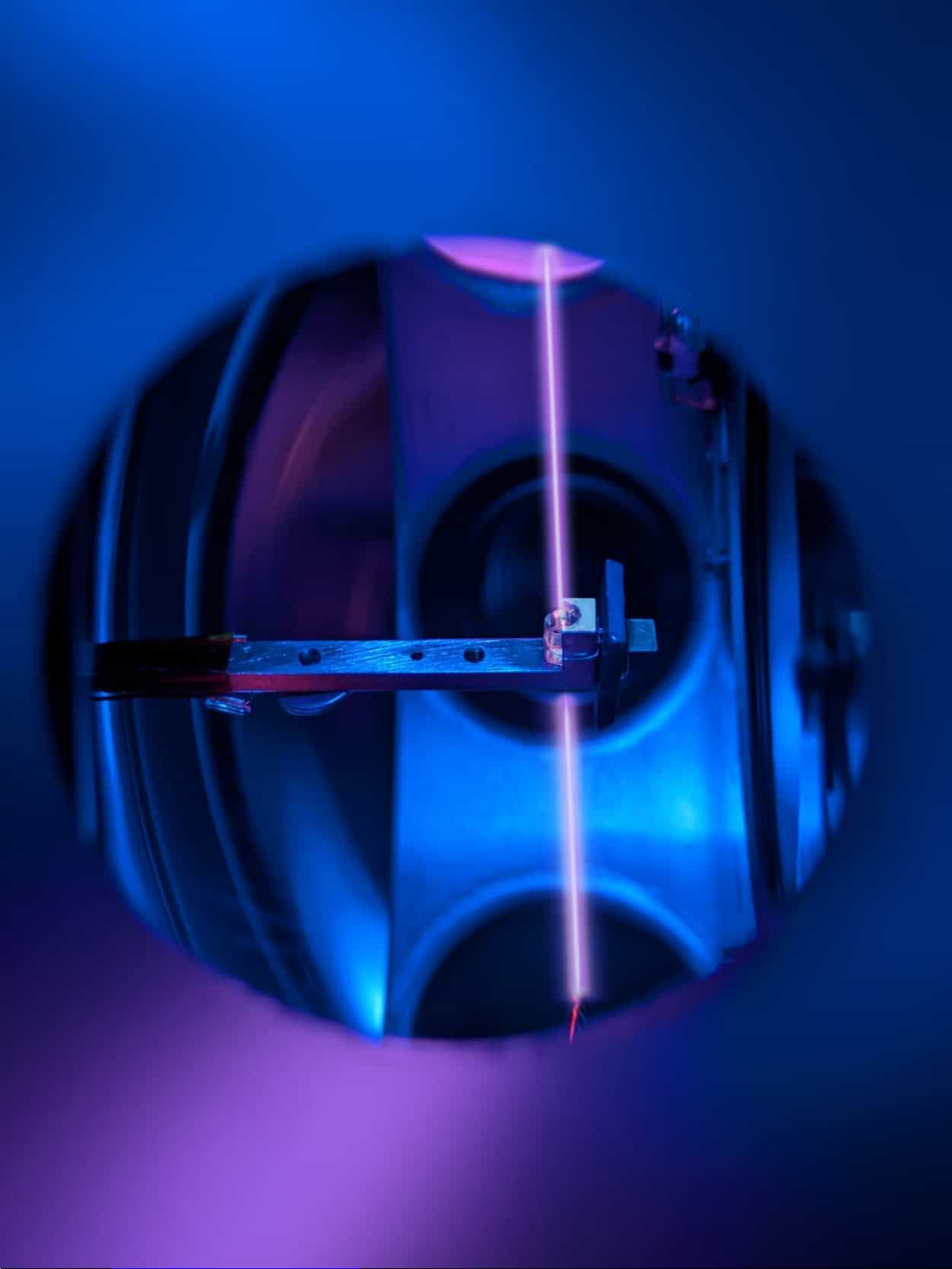
Nuclear clock: The thorium crystal and laser beam used in the experiment at TU Wien. (Courtesy: TU Wien)
Two independent teams have realized the first clocks based on transitions within atomic nuclei. The new nuclear clocks represent the culmination of more than 20 years of research and could become vital tools in precision tests of fundamental physics.
Today’s most accurate clocks “tick” whenever an electron transitions between two specific hyperfine levels in the ground state of an atom. These atomic clocks form a vital part of technologies such as satellite navigation and telecommunications networks. They also contribute to fundamental research in dark matter searches and gravitational wave detection.
Traditionally, the hyperfine levels used in atomic clocks are separated by gaps with frequencies in the microwave range. However, more modern atomic clocks use higher-frequency optical transitions.…