Theoretically speaking, black holes should breathe stuff out as they suck stuff in. But for 50 years, astronomers weren’t able to confirm this was true for the supermassive black hole in our own galaxy—until now.
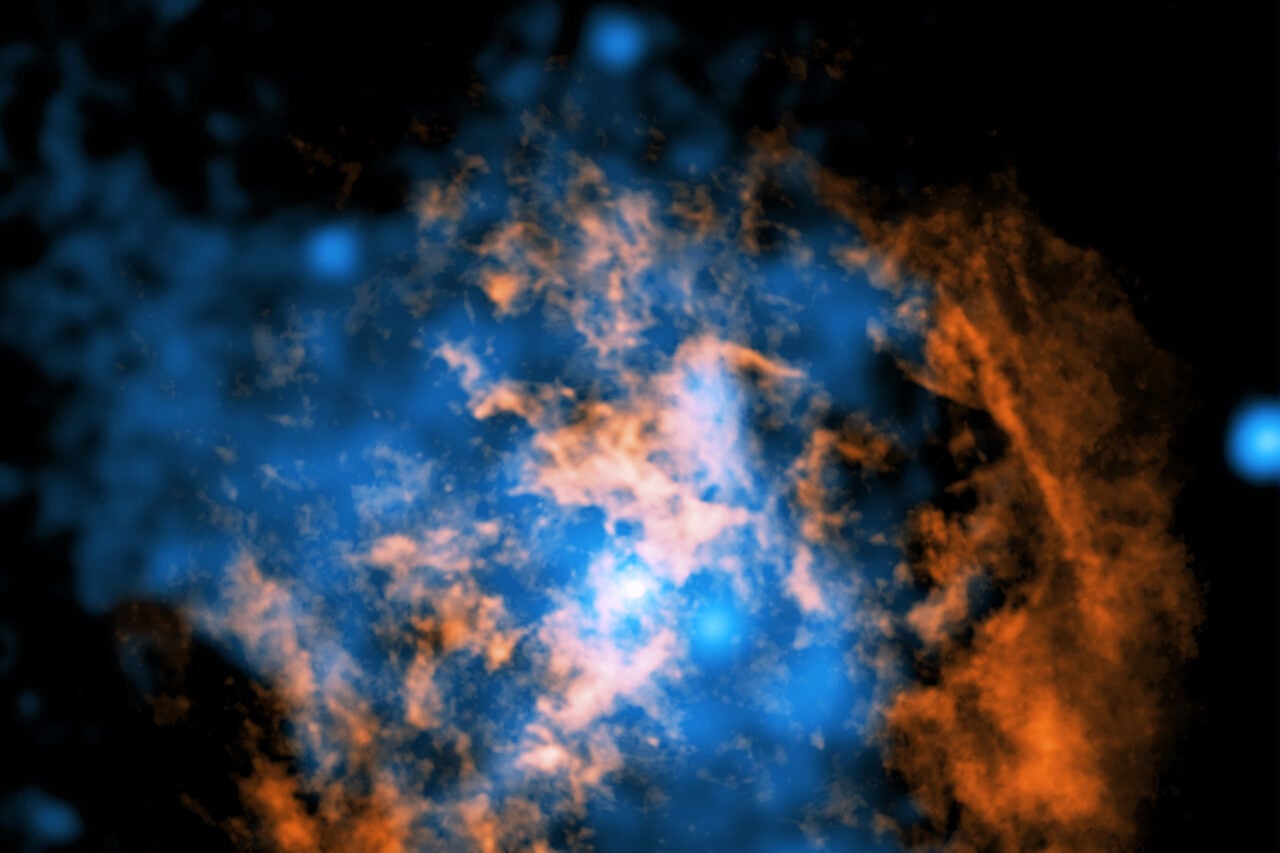
In a study published yesterday in The Astrophysical Journal Letters, astrophysicists at Northwestern University presented potential evidence of a giant, cone-shaped hole in the cold gas surrounding Sagittarius A*, the supermassive black hole at the center of the Milky Way. When the team calculated how much energy was required to create this cavity, they found there had to be some input from the black hole—something like a powerful wind or jet. To arrive at these conclusions, the team compiled five years’ worth of observations by the Atacama Large Millimeter/submillimeter Array (ALMA) in Chile.
“Unless a black hole exists in a perfect vacuum, it must blow a wind somehow,” study co-lead author Mark Gorski said in a statement .…