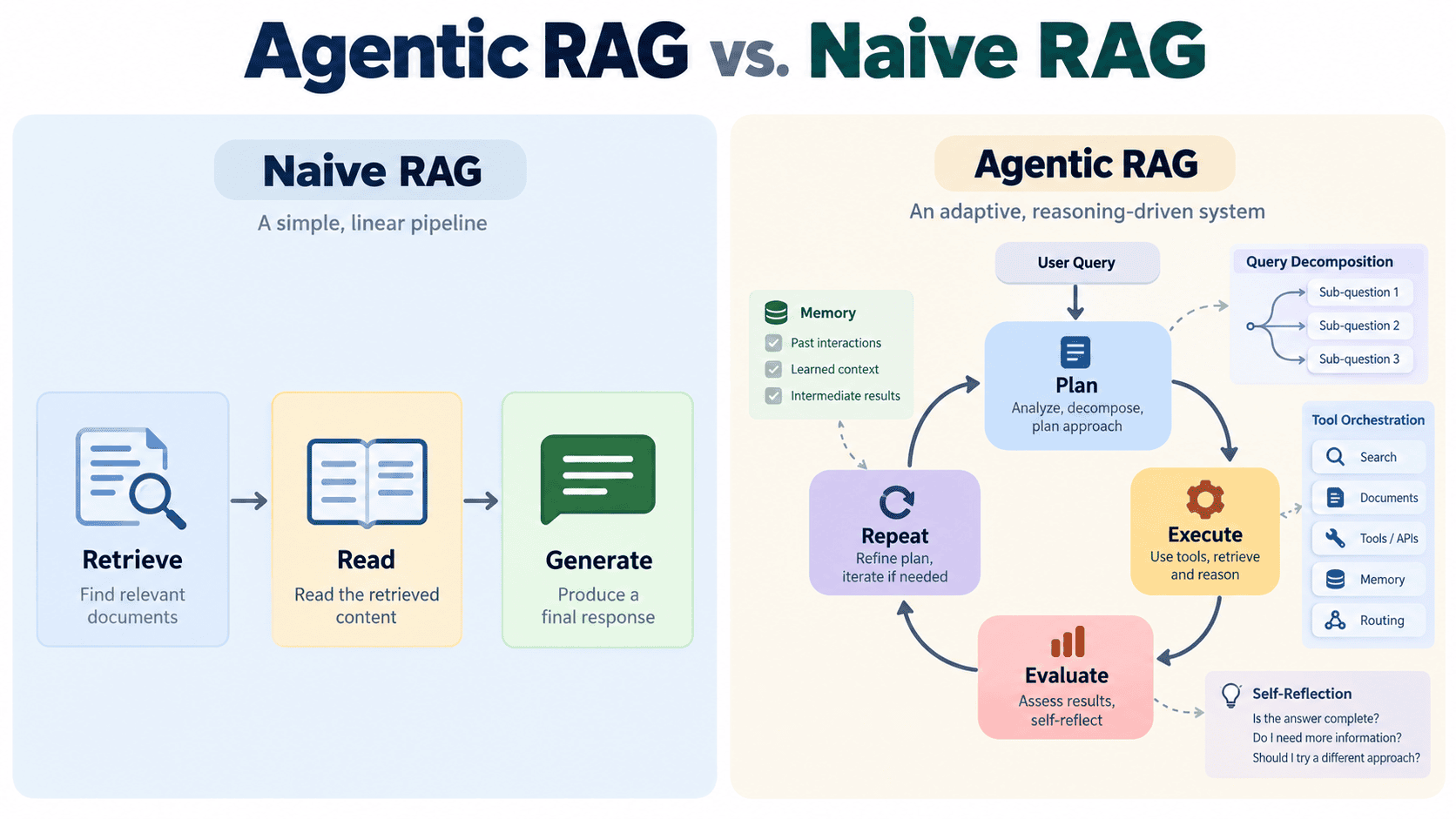
Large language models are remarkable text generators, but they have a well-documented weakness: they hallucinate. Without access to verified, up-to-date information, they confidently produce plausible-sounding answers that are factually wrong. Retrieval-Augmented Generation (RAG) emerged as the standard solution, grounding model outputs in external knowledge sources and dramatically reducing hallucinations across enterprise applications.
But as organizations push these systems into more complex workflows, a new problem has surfaced. Standard RAG pipelines are linear — they retrieve once, pass those results to the model, and generate an answer. When the query is simple and the knowledge base is well-structured, this works fine. When the query requires multi-step reasoning, cross-referencing multiple sources, or synthesizing information that doesn't exist in a single document, the pipeline starts to crack.
That's where Agentic RAG comes in.…