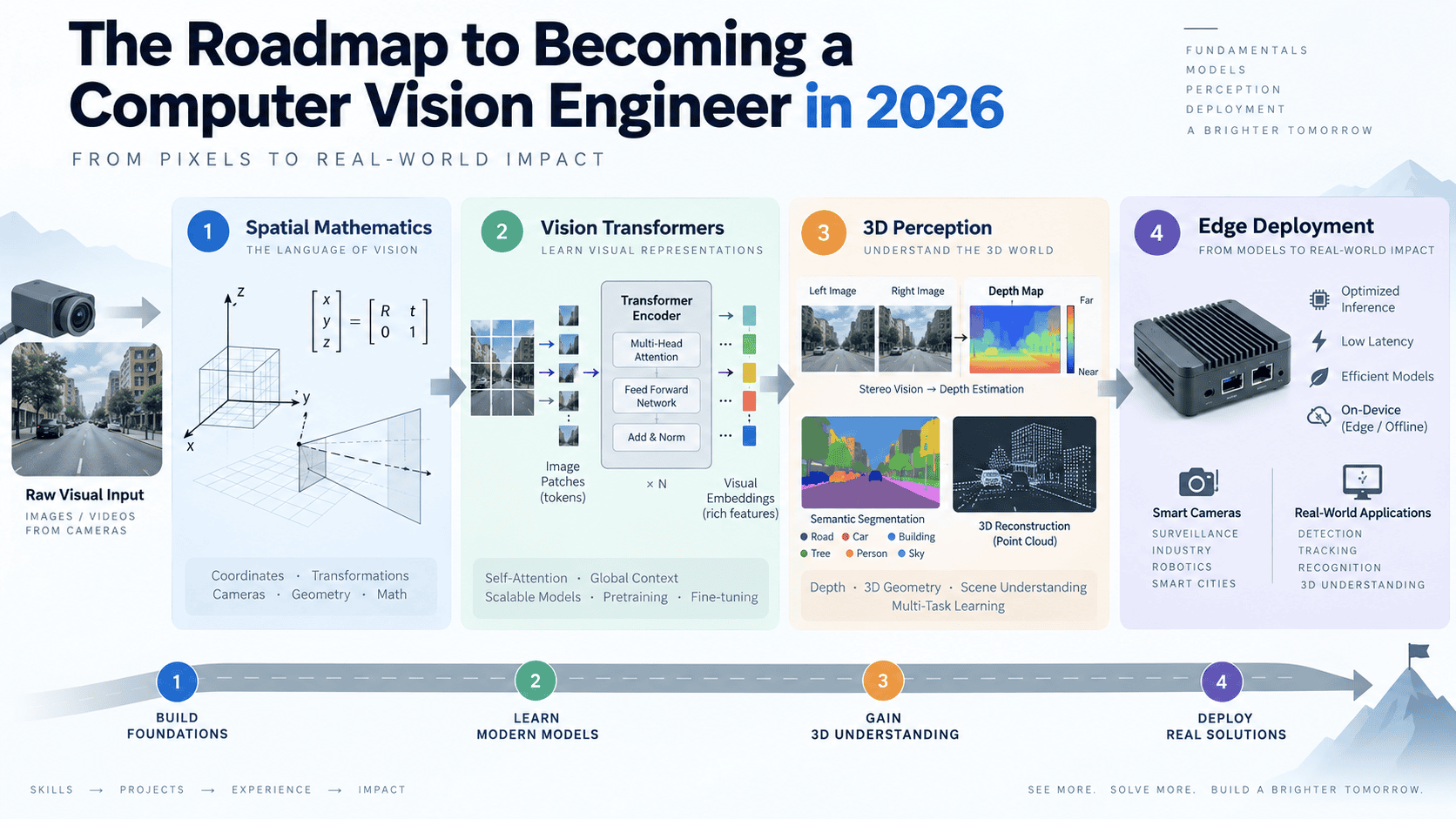
Computer vision (CV) has moved far beyond object detection and image classification. In 2026, CV engineers work at the intersection of foundation models, spatial computing, and embedded hardware, building systems that perceive, reason over, and act on the visual world in real time.
The demand for engineers who can operate across this full stack is growing steadily. Autonomous vehicles, robotic warehouses, medical imaging platforms, and spatial computing devices all share a common need: engineers who understand not just model architecture, but the full pipeline from sensor to production inference.
This roadmap covers four stages, progressing from the spatial mathematics and foundational vision primitives that everything else depends on, through to edge deployment and hardware-aware optimization. Each stage builds directly on the previous one.
Step 1: Spatial Mathematics and Foundation Vision Primitives
Every CV system is ultimately a system for reasoning about geometry.…