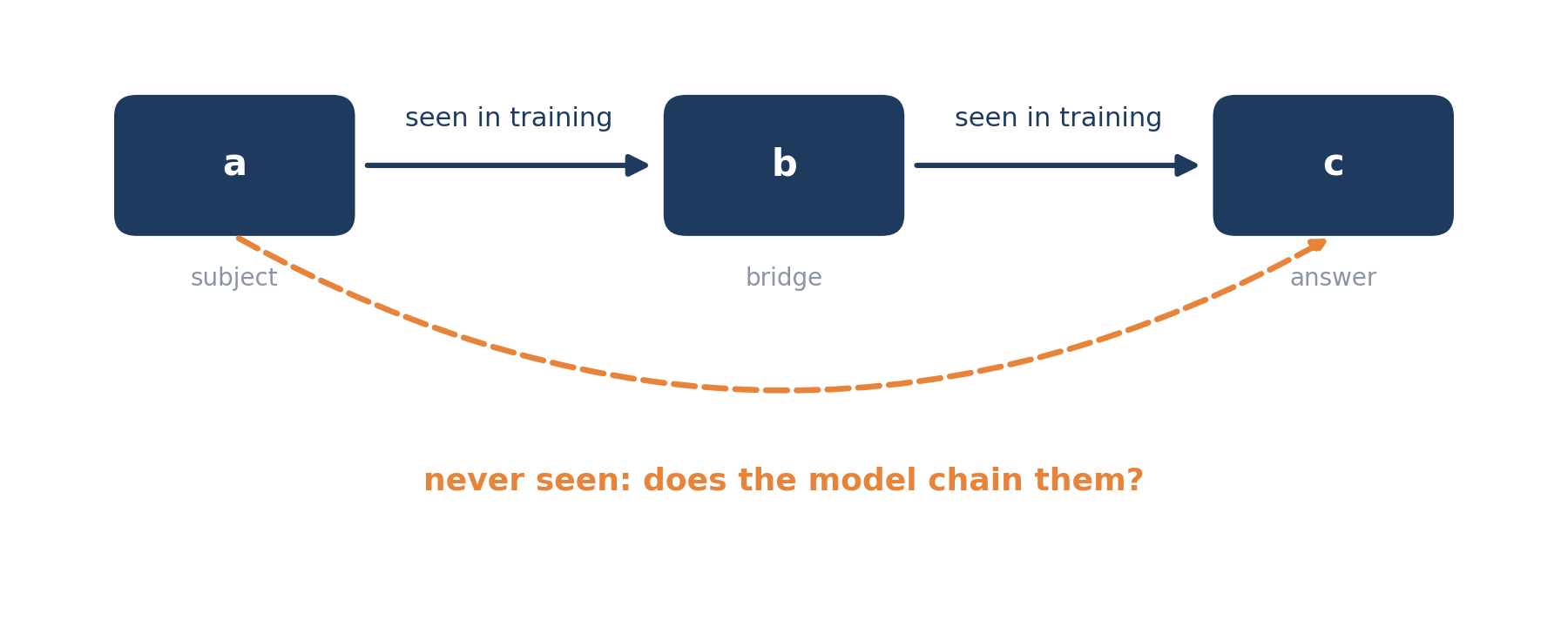
Ask a language model "Who is the spouse of the performer of Imagine?" and a good one will get it right, as long as it can think out loud first: who performed the song, then who that person married. Make it answer in a single step with no visible reasoning and things get shakier.
Balesni, Korbak and Evans [1] wanted to know how deep that weakness goes. Their trick was to fine-tune models on invented facts, so the answer can't come from some half-remembered shortcut in the training data. When the two facts showed up together in the same training document, the models could chain them. When the same two facts were learned from separate documents, accuracy fell to chance. They named this the Two-Hop Curse.
I've written about the Reversal Curse before, where a model that learns "A is B" can't answer "B is A" [3]. The two-hop version looked like a close cousin, and it has the same property that makes these papers fun: you can rebuild the whole thing at a scale where you can look at every number.…