There are growing signs that humanity’s best bet for detecting extraterrestrial life could be statistics. Abigail Williams speaks to the research teams around the world that are paving the way for new breakthroughs in astrobiology and astrochemistry
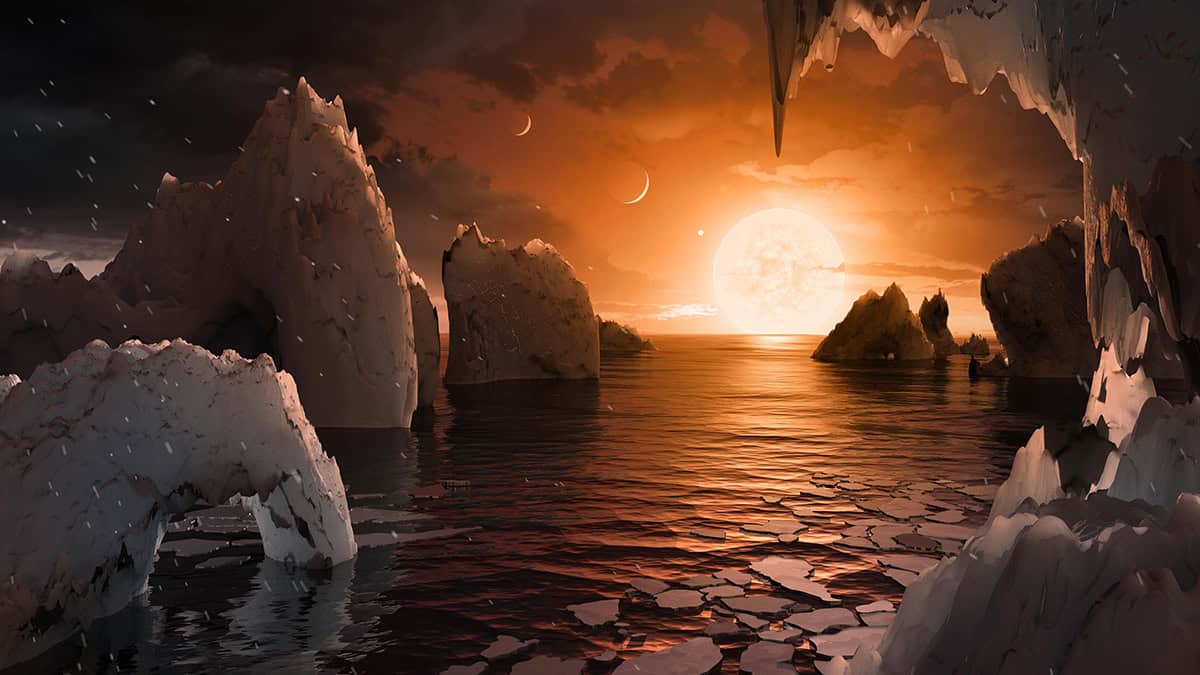
This artist's concept allows us to imagine what it would be like to stand on the surface of the exoplanet TRAPPIST-1f, located in the TRAPPIST-1 system in the constellation Aquarius. (Courtesy: NASA/JPL-Caltech)
Are we alone in the universe? It’s hard to know exactly how long this fundamental question has perplexed humanity. But it’s likely that throughout history, generations of people have looked up at the stars and wondered if life is unique to Earth. In the modern era, our search for life beyond Earth has intensified thanks to an ever-growing array of sophisticated astronomical and scientific instruments and technologies.
Furthermore, our search for signs of alien biology and chemistry already has a multitude of targets.…