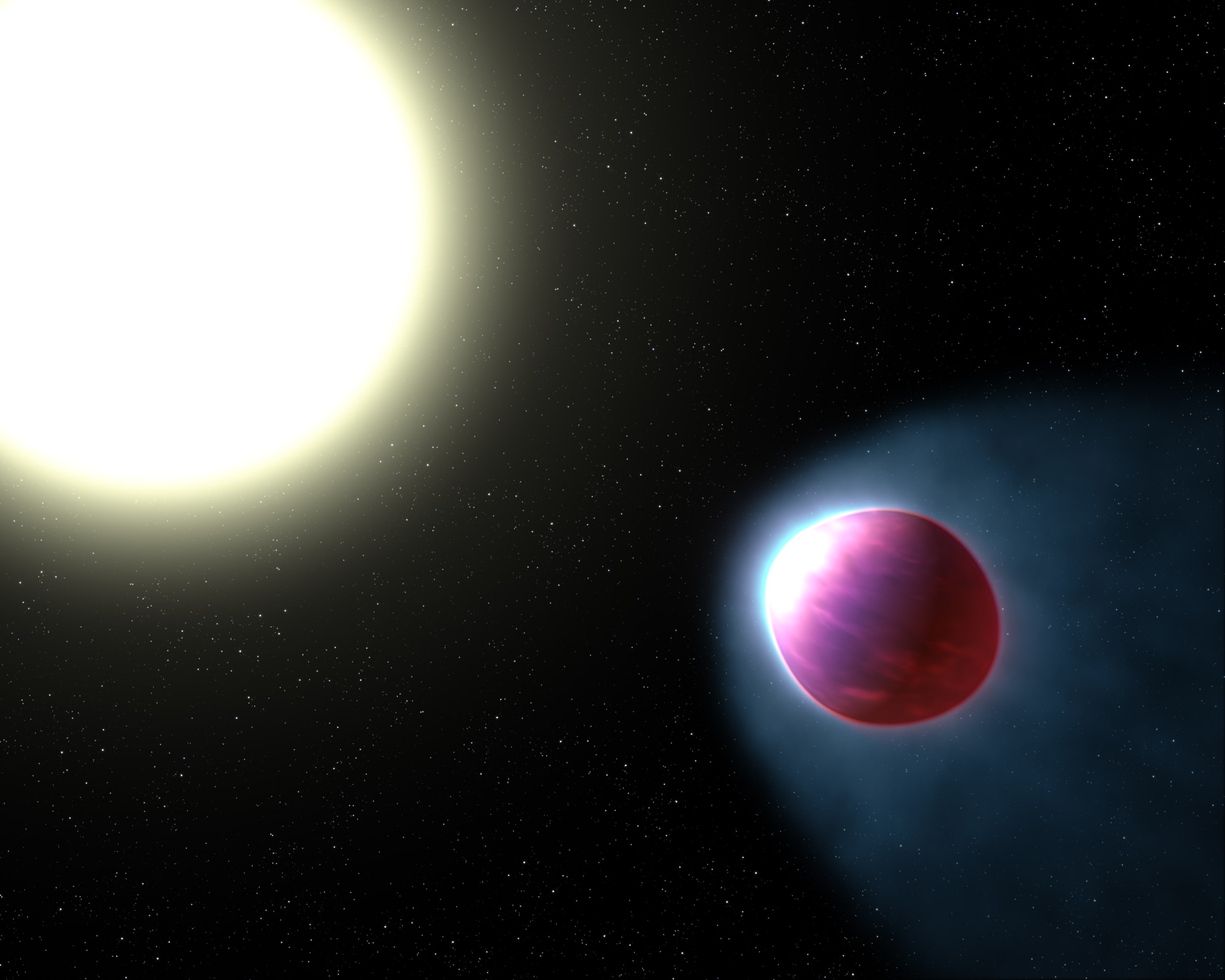
Planets have enough mass that gravity molds them into a roughly spherical shape, but they can deviate from perfect spheres.
| Published: November 16, 2026
Exoplanet WASP-121 b, shown here in an artist’s concept, has been stretched into an oblong, football-esque shape by the gravitational forces of the star it orbits. Credit: NASA, ESA, and G. Bacon (STScI)
Could planets that orbit other stars be nonspherical shapes, such as ovals or pears, depending on composition?
Rich Livitski
Seal Beach, California
Bodies large enough to be considered planets have enough mass that gravity molds them into a roughly spherical shape.
The key word here is roughly — other factors also come into play, such as a planet’s composition (rocky or gassy) and its rate of spin. The faster a planet spins, the more its rotation causes it to bulge outward at the equator.…