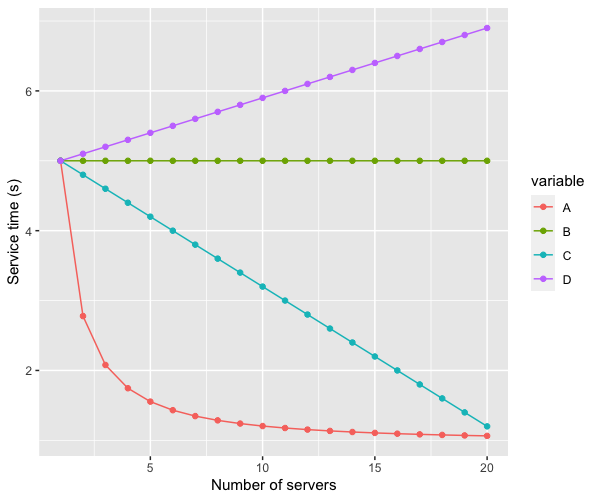
The M/M/c model may not behave like you expect. I have a system with c servers, each of which can only handle a single concurrent request, and has no internal queuing. The servers sit behind a load balancer, which contains an infinite queue. An unlimited number of clients offer c * 0.8 requests per second to the load balancer on average. In other words, we increase the offered load linearly with c to keep the per-server load constant. Once a request arrives at a server, it takes one second to process, on average. How does the client-observed mean request time vary with c ? Option A is that the mean latency decreases quickly, asymptotically approaching one second as c increases (in other words, the time spent in queue approaches zero). Option B is constant. Option C is a linear improvement, and D is a linear degradation in latency. Which curve do you, intuitively, think that the latency will follow?…