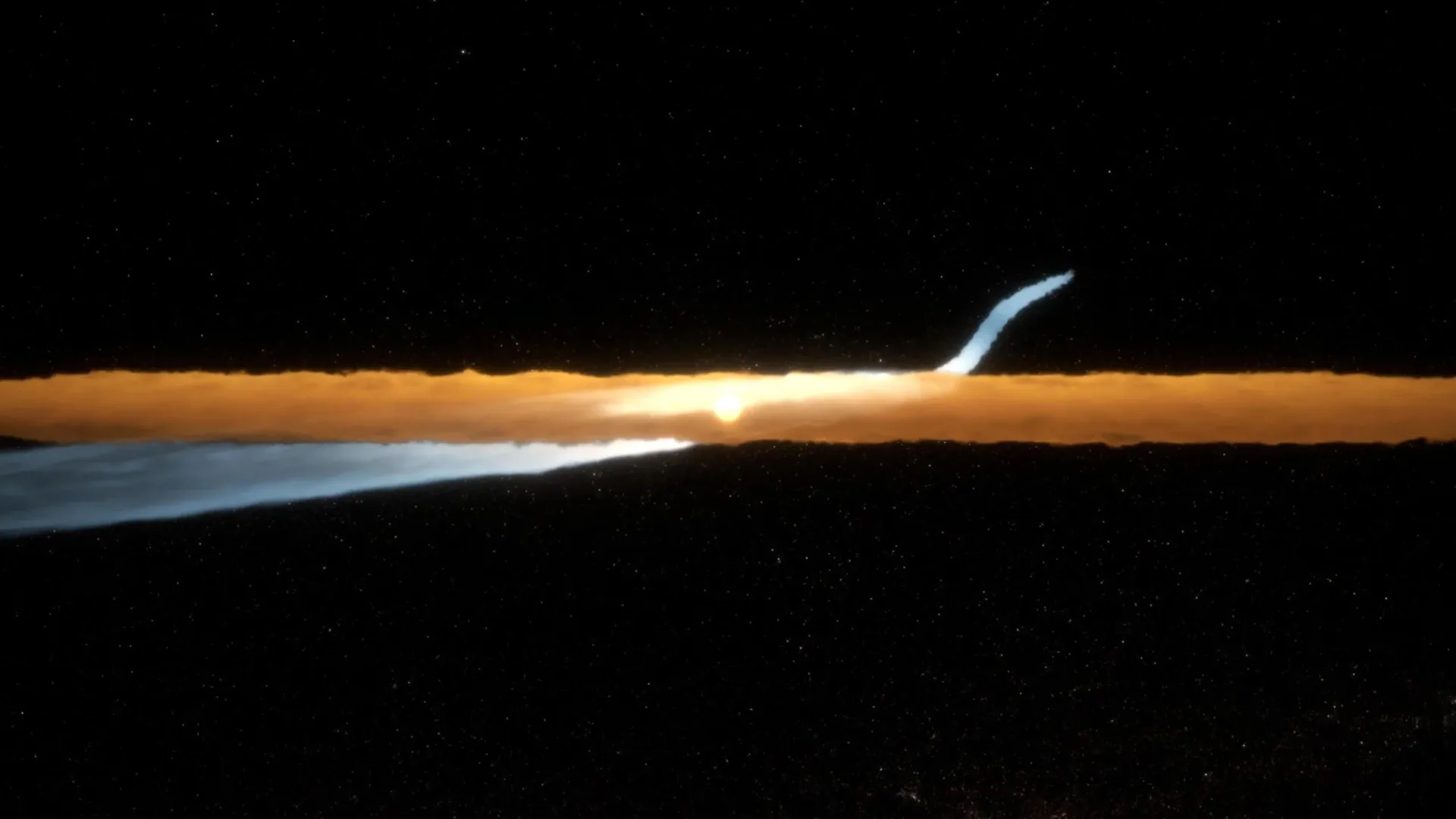
A mysterious structure stretching roughly 93 billion miles across space is giving astronomers new clues about the violent events that shape young planetary systems. Known as the "Cat's Tail," this enormous cloud of dark material lies about 63 light-years from Earth, in the faint constellation Pictor (which is Latin for "painter"). For the past two years, its unusual appearance and uncertain origins have puzzled scientists.
The structure is part of a vast disk of dust and debris surrounding Beta Pictoris, a young star system that resembles our own solar system during its early development. Now, using NASA's Hubble Space Telescope, astronomers have captured previously hidden details of the Cat's Tail in visible light for the first time.
The discovery is described in a study published in The Astrophysical Journal Letters . Led by University of Arizona planetary scientist Arin Avsar, the research team combined the new Hubble images with observations spanning more than 14 years.…